
Billiard Pool Table Basics: Essential Pool Table Parts for Beginners
📋 Table of Contents
- 1. What is a Pool Table? Understanding the Basics
- 2. Pool Table Dimensions and Layout Overview
- 3. Essential Pool Table Parts: The Playing Surface
- 4. Rails and Cushions: The Boundaries of Play
- 5. Pockets and Spots: Key Reference Points
- 6. Markings and Strings: Navigation on the Table
- 7. Pool Table Diagram: Complete Visual Guide
1. What is a Pool Table? Understanding the Basics
A pool table, also called a billiard table, is a bounded playing surface designed for cue sports. The table features a flat playing area covered in cloth, surrounded by cushioned rails, and equipped with pockets where balls are targeted. Pool tables come in various sizes, but all share the same fundamental components and proportions.
Standard Pool Table Sizes
Pool tables are manufactured in several standard sizes to accommodate different spaces and skill levels:
- Professional Tournament Size: 9 feet × 4.5 feet (2.74m × 1.37m)
- Regulation Size: 8 feet × 4 feet (2.44m × 1.22m)
- Home/Bar Size: 7 feet × 3.5 feet (2.13m × 1.07m)
- Small Home Size: 6 feet × 3 feet (1.83m × 0.91m)
All regulation pool tables maintain a 2:1 length-to-width ratio. This means the playing surface is exactly twice as long as it is wide. This standardization ensures consistent gameplay across all table sizes and allows players to develop transferable skills regardless of the table they're playing on.
Why Learning Table Anatomy Matters
Understanding pool table parts is essential for several important reasons:
- Following Game Rules: Many rules reference specific table areas like "the kitchen" or "behind the head string." Without knowing these terms, you can't play correctly.
- Improving Your Game: Professional players use table markings for aiming, positioning, and strategy. Understanding the table's geometry gives you these same advantages.
- Effective Communication: When discussing shots or receiving instruction, knowing proper terminology prevents confusion and speeds up learning.
- Equipment Selection: If you're buying a table, understanding quality indicators in each component helps you make informed decisions.
- Maintenance and Care: Proper table care requires knowing what each part does and how it should function.
Basic Components Overview
Every pool table consists of these fundamental elements:
- Playing Surface: The flat cloth-covered area where balls roll
- Rails: The raised wooden borders surrounding the playing surface
- Cushions: Rubber bumpers attached to rails that provide ball rebound
- Pockets: Six openings where balls are targeted (four corners, two sides)
- Cloth (Felt): Specialized fabric covering the playing surface
- Reference Marks: Spots, strings, and diamonds that serve as positioning guides
In the following sections, we'll explore each of these components in detail, helping you understand not just what they are, but why they matter for your game.
2. Pool Table Dimensions and Layout Overview
Before diving into individual components, it's crucial to understand the overall layout and orientation of a pool table. Just like a map needs north, south, east, and west, pool tables have specific directional terms that players use constantly.
Understanding Table Orientation: Head to Foot
Pool tables have two designated ends that define the playing direction and establish reference points for all rules and positioning:
Head of Table
The head of the table is the end where players stand to break. This is your starting position at the beginning of each game. Think of it as "home base" - where the action begins. The head of the table is always the end from which you initiate play.
- Location: The breaking end of the table
- Purpose: Starting position for most games
- Key feature: Contains the "kitchen" (breaking area)
- Common usage: "Break from behind the head string"
Foot of Table
The foot of the table is the opposite end where balls are racked at the start of the game. This is your target area - where the action happens. When someone says "rack them at the foot," they're referring to this end of the table.
- Location: The opposite end from where you break
- Purpose: Ball racking position
- Key feature: Contains the foot spot (rack center point)
- Common usage: "Rack the balls on the foot spot"
💡 Easy Way to Remember:
Head = Break (where you start)
Foot = Rack (where balls are set up)
Think of walking toward something: your head leads (breaking), your feet arrive at the destination (racked balls).

Playing Surface Dimensions
It's important to distinguish between the overall table dimensions and the actual playing surface:
For a 9-Foot Table:
- Overall dimensions: 9 feet × 4.5 feet (including rails)
- Playing surface: Approximately 100 inches × 50 inches (8.33 ft × 4.17 ft)
- Rail width: Typically 4-5 inches on each side
For an 8-Foot Table:
- Overall dimensions: 8 feet × 4 feet (including rails)
- Playing surface: Approximately 88 inches × 44 inches (7.33 ft × 3.67 ft)
- Rail width: Typically 4-5 inches on each side
The table itself is just part of the space equation. You need adequate room around the table for cue stick clearance:
- Minimum clearance: 5 feet on all sides (58-inch cue)
- Recommended clearance: 6 feet on all sides (more comfortable play)
- For 9-foot table: Room should be at least 18 ft × 14 ft
- For 8-foot table: Room should be at least 17 ft × 13 ft
Table Height Standards
Pool tables have standardized heights to ensure consistent play:
- Standard playing surface height: 29.25 inches to 31 inches from the floor
- Most common height: 30 to 31 inches
- Why it matters: Proper height allows for comfortable stance and accurate cueing
Why Orientation Matters
Understanding head versus foot is essential because:
- Rule References: Game rules constantly reference these terms. "Ball in hand behind the head string" means something specific.
- Setup Procedures: Knowing where to rack and where to break is fundamental to starting any game correctly.
- Strategic Communication: Players discuss positioning using these terms: "Leave him at the head end" or "position for the foot spot."
- Table Installation: When setting up a new table, establishing head and foot determines pocket positioning and lighting placement.
When you approach a pool table for the first time, mentally label the ends: "This is where I break (head), that's where balls are racked (foot)." Establishing this orientation first makes everything else about the table easier to understand.
3. Essential Pool Table Parts: The Playing Surface
The playing surface is the heart of any pool table. What appears to be a simple flat green surface is actually a sophisticated combination of materials engineered for precision and durability. Understanding these components helps you appreciate why quality tables play differently and what to look for when purchasing equipment.
The Cloth (Felt)
The cloth, commonly called "felt," is the fabric covering the playing surface. However, pool table cloth isn't actually felt at all - it's a tightly woven worsted wool or wool-nylon blend designed for specific playing characteristics.
Cloth Characteristics:
- Material: Worsted wool (professional) or wool-nylon blend (recreational)
- Weight: Measured in ounces per yard; heavier = more durable
- Weave: Tighter weave = faster play and more accurate ball roll
- Nap: Direction of the fabric weave affects ball direction slightly
Why Green?
The traditional green color isn't just aesthetics. Green was chosen because:
- Easier on the eyes during extended play
- Provides good contrast with colored balls
- Historical connection to lawn games (billiards evolved from outdoor games)
- Reduces glare under bright lighting
Modern tables also come in blue, burgundy, gray, and other colors, but green remains the most common for traditional play.
Cloth Quality Indicators:
- Professional Grade: Simonis, Championship, or other worsted wool brands
- Recreational Grade: Wool-nylon blends for home use
- Speed Rating: Professional cloth is faster; balls roll farther with less effort
- Durability: Higher quality cloth lasts 3-5 years with regular use
The Slate Bed
Underneath the cloth lies the most critical component of a quality pool table: the slate bed. This is the actual playing surface that determines how true and level your balls will roll.
Why Slate?
Slate is used for pool tables because it offers unique properties:
- Perfect flatness: Can be ground to within 0.01 inches of perfectly flat
- Weight provides stability: Heavy slate doesn't shift or vibrate during play
- Won't warp: Unlike wood, slate doesn't expand, contract, or warp with humidity
- Smooth surface: Provides ideal foundation for cloth
- Durability: Lasts indefinitely when properly maintained
Slate Configuration:
Professional tables use slate in one of two configurations:
Three-Piece Slate (Most Common):
- Three separate slate pieces joined together
- Easier to move and install
- Can be leveled more precisely
- Standard for 8-foot and 9-foot tables
- Seams are filled and smoothed (invisible during play)
One-Piece Slate:
- Single solid piece of slate
- No seams to maintain
- Very heavy and difficult to move
- Common on 7-foot tables
- Premium option for dedicated game rooms
Slate Thickness:
- Professional Standard: 1 inch (25mm) thick
- Recreational Standard: ¾ inch (19mm) thick
- Lower-end Tables: ½ inch (12mm) or less
Some lower-cost tables use MDF (medium-density fiberboard), particleboard, or synthetic materials instead of slate. These alternatives:
- Warp over time with humidity changes
- Cannot be leveled as precisely
- Provide inconsistent ball roll
- Wear unevenly under the cloth

The Frame and Legs
Supporting all of this weight is the table frame and leg system. A 9-foot slate table can weigh 1,000 pounds or more, requiring robust construction.
Frame Construction:
- Material: Hardwood or steel frame
- Purpose: Supports slate weight evenly
- Cross-supports: Prevent sagging over time
- Slate supports: Wooden or metal strips that hold slate in place
Leg Design:
- Four-leg design: Most common, provides stable support
- Six-leg design: Added support for larger tables
- Leg levelers: Adjustable feet for precise leveling
- Styles: Vary from simple posts to ornate carved designs
Leveling Importance:
A level playing surface is absolutely critical:
- Professional tables are leveled to within 0.001 inches
- Even slight variations affect ball roll
- Leveling should be checked annually
- Use a machinist's level (not a standard carpenter's level)
A simple way to check table level: Place a penny on edge at the center spot. A properly leveled table will keep the penny standing upright without rolling in any direction. If it falls, your table needs leveling adjustment.
4. Rails and Cushions: The Boundaries of Play
The rails and cushions define the playing boundaries and provide the characteristic ball rebound that makes pool possible. Understanding these components helps you predict ball behavior and use rail shots effectively.
Understanding the Rails
Rails are the wooden borders that frame the playing surface. Each pool table has six rails total, divided into two types based on their position and length.
Short Rails (Head Rail & Foot Rail)
The short rails are located at the head and foot ends of the table:
- Head Rail (Short or Head Rail): Located at the head of the table (breaking end)
- Foot Rail (Short or Foot Rail): Located at the foot of the table (racking end)
- Length: Approximately half the length of the long rails
- Purpose: Define the width boundaries of the playing surface
Long Rails (Side Rails)
The long rails run the length of the table on both sides:
- Location: Left and right sides of the table
- Length: Span from head to foot, broken only by side pockets
- Purpose: Define the length boundaries of the playing surface
- Usage: Most commonly used for bank shots and position play
💡 Rail Terminology:
When players say "hit it off the rail," they mean banking the ball off one of these cushioned borders. The terms "rail" and "cushion" are often used interchangeably in casual conversation, though technically they're different components.
The Cushions: The Rubber Bumpers
Cushions are the rubber strips attached to the inner edge of each rail. These provide the essential rebound that allows balls to bounce predictably off the table edges.
Cushion Construction:
- Material: Natural rubber or synthetic rubber compound
- Shape: Triangular profile (K-66 is professional standard)
- Attachment: Glued to the wooden rail with specialized adhesive
- Height: Precisely matched to ball diameter (63.5% of ball height)
K-66 Profile Standard:
The K-66 cushion profile is the industry standard for professional play:
- Triangular cross-section with specific angle (approximately 15°)
- Provides consistent rebound across entire rail
- Ball contacts cushion at the center point
- Creates predictable angle reflection
Cushion Quality Indicators:
- Responsiveness: Should provide 75-80% rebound (ball returns ¾ the distance it came from)
- Consistency: All cushions should respond identically
- Temperature sensitivity: Quality cushions maintain performance across temperature ranges
- Longevity: Good cushions last 20-25 years; deteriorate faster in temperature extremes
- Dead spots (areas with reduced bounce)
- Balls bouncing higher than they should
- Inconsistent angles off rails
- Visible hardening or cracking of rubber
- Balls sticking to or rolling along the cushion
Rail Diamonds (Sight Markers)
Along each rail, you'll notice small circular or diamond-shaped markers inlaid into the wood. These are called rail diamonds or sight markers, and they're crucial reference points for aiming and positioning.
Diamond Placement:
- Long rails: Typically 8 diamonds per rail (evenly spaced)
- Short rails: Typically 4 diamonds per rail (evenly spaced)
- Spacing: Diamonds divide the rail into equal segments
- Material: Usually white or contrasting inlay for visibility
How Players Use Diamonds:
Banking Systems:
Advanced players use diamond systems to calculate precise bank shots. By counting diamonds, they can predict where a ball will travel after banking off one or more rails.
Position Reference:
Diamonds help players communicate position: "The cue ball is two diamonds from the corner" tells another player exactly where to look.
Aiming Points:
For shots requiring rail contact, diamonds serve as aiming reference points, making it easier to visualize the shot path.
Kick Shot Calculations:
When the object ball is blocked, diamonds help calculate kick shots (hitting a rail first before contacting the object ball).
Professional players learn sophisticated "diamond systems" - mathematical approaches to banking and kicking using the rail diamonds as calculation points. While these systems can seem complex, they're based on simple geometry: the angle of incidence equals the angle of reflection. Diamonds just make visualizing and calculating these angles easier.
Rail and Cushion Maintenance
Proper care extends the life of rails and cushions:
- Keep temperature stable: Extreme heat or cold damages rubber cushions
- Maintain humidity: 40-50% relative humidity prevents wood warping
- Clean regularly: Wipe rails with slightly damp cloth
- Avoid leaning: Don't lean body weight on rails; this stresses cushion glue
- Check tightness: Rails should be firmly attached to the table frame

🎯 Master Table Positioning with Ghost Ball Aim Trainer
Now that you understand table anatomy, learn to use these reference points for perfect aiming with our specialized training tool:
- Practice using rail diamonds for banking shots
- Develop muscle memory for pocket angles
- Master cue ball positioning from any spot on the table
- Visualize shot paths using table reference points
- Accelerate your understanding of table geometry
Understanding where everything is on the table is the first step. The Ghost Ball Aim Trainer helps you use this knowledge to make accurate shots consistently.
Shop Ghost Ball Trainer →
5. Pockets and Spots: Key Reference Points
Pockets are the ultimate destination for every shot in pool, while spots are the invisible anchors that define where balls are placed and where players aim. Together, these elements create the fundamental targets and reference points that structure every game.
The Six Pockets
Every regulation pool table has exactly six pockets - four corner pockets and two side pockets. Understanding their characteristics helps you select smarter shots and develop realistic expectations for difficulty.
Corner Pockets (4 Total)
The corner pockets are located at each of the four corners of the table:
- Location: Where two rails meet at right angles
- Opening width: Typically 4.5 to 5 inches wide
- Acceptance angle: Wider than side pockets (approximately 142°)
- Difficulty: Easier targets due to two-rail funnel effect
- Naming: Identified by position (e.g., "upper right corner," "foot corner")
Why Corner Pockets Are Easier:
When a ball approaches a corner pocket at an angle, both adjoining cushions help guide it toward the opening. This "funnel effect" means balls don't need to be aimed as precisely - there's more margin for error. Additionally, the wider acceptance angle means balls approaching from various angles still have a chance of dropping.
Side Pockets (2 Total)
The side pockets are located at the midpoint of each long rail:
- Location: Center of each long rail
- Opening width: Typically 5 to 5.5 inches wide (0.5-1 inch wider than corners)
- Acceptance angle: Narrower than corners (approximately 103°)
- Difficulty: More challenging due to narrow approach angles
- Common issue: Balls can "rattle" in the pocket jaws without falling
Why Side Pockets Are Harder:
Despite being physically wider, side pockets are more difficult because:
- Narrower acceptance angle rejects balls at sharp angles
- No cushion funnel effect - one side only
- Pocket "points" (corners) can deflect balls back onto the table
- Speed control is more critical - too hard and balls bounce out
💡 Pocket Selection Strategy:
When you have a choice between pocketing a ball in a corner versus a side pocket from similar distances, the corner pocket is almost always the higher-percentage shot. Save side pocket attempts for situations where they're clearly the best tactical choice or when you need to work on this more difficult skill.
Pocket Construction
Understanding pocket anatomy helps you predict ball behavior:
- Pocket openings: Cut into the playing surface and rails
- Pocket liners: Leather, rubber, or plastic funnels guide balls downward
- Pocket drop: How steeply balls fall affects whether they rattle out
- Pocket shelves: Narrow ledges at opening can catch balls or send them back
The Three Spots
Pool tables have three key spots that serve as precise reference points. These spots are small circular marks on the cloth, typically about the size of a pencil eraser. While not always visible on older or heavily-used tables, their positions are standardized and critical for rule-following.
Foot Spot
The foot spot is located at the foot end of the table and is the most frequently used reference point:
- Location: At the intersection of the foot string and center string
- Distance from foot rail: One-quarter of the table length
- Primary use: Center point for racking balls
- Secondary use: Spot for replacing balls in certain games
In Practice:
When you set up the triangle rack for 8-ball or 9-ball, the apex ball (front ball) sits directly on the foot spot. This standardization ensures consistent breaking conditions across all tables.
Center Spot
The center spot is located at the geometric center of the table:
- Location: Exact center of the playing surface
- Distance from any rail: Equal distance to all rails
- Primary use: Reference point for certain games
- Secondary use: Measurement reference for table maintenance
In Practice:
The center spot sees less action in common games like 8-ball and 9-ball, but is crucial in games like straight pool and some snooker-derived games. It's also used by table mechanics for leveling and alignment checks.
Head Spot
The head spot is located at the head end of the table:
- Location: At the intersection of the head string and center string
- Distance from head rail: One-quarter of the table length
- Primary use: Placement point for specific game rules
- Secondary use: Reference for "behind the head string" positioning
In Practice:
The head spot is less frequently used than the foot spot in common games, but it's essential in games where you need to place balls at the opposite end from the rack.
The three spots are always positioned in a straight line down the exact center of the table (the center string). The foot spot is closest to the racking end, the center spot is in the middle, and the head spot is closest to the breaking end. Think of them as three stepping stones marking the center path from head to foot.
How Spots Are Marked
Different manufacturers mark spots in various ways:
- Cloth circles: Small circular patches of contrasting cloth sewn into the main cloth
- Printed marks: Ink or dye applied directly to the cloth
- Stick-on markers: Small adhesive dots (not ideal - can shift or fall off)
- Invisible but known: Some tables have no visible spots, but positions are standardized
Using Spots for Game Setup
Different games use the spots in different ways:
8-Ball:
- Rack with apex ball on foot spot
- 8-ball in center of rack
- One stripe and one solid in back corners
9-Ball:
- Use diamond rack with 1-ball on foot spot
- 9-ball in center of diamond
- Other balls placed randomly
Straight Pool:
- Break ball on foot spot (or as close as possible)
- After each rack, continue from current positions
Be aware that balls near the spots but close to pocket openings can be deceptive. A ball might look like it's sitting on the foot spot but actually be positioned where it could fall into a corner pocket with just slight movement. Always verify ball position relative to both the spot and nearby pockets before assuming it needs to be "spotted."
6. Markings and Strings: Navigation on the Table
Beyond the visible cloth and pockets, pool tables have invisible reference lines called "strings" that divide the playing surface into zones. These imaginary lines are critical for understanding game rules and strategic positioning. While you can't see them, experienced players visualize these lines constantly during play.
The Three Strings (Imaginary Lines)
Pool tables have three primary reference lines called "strings." These are imaginary lines that aren't marked on the cloth but are defined by their relationship to the spots and rails. Think of them as the longitude and latitude lines of your pool table map.
Head String
The head string is an imaginary line running parallel to the head rail:
- Location: Passes through the head spot
- Orientation: Parallel to the short rail at the head of the table
- Distance from head rail: Exactly one-quarter of the table length
- Extends: From the second diamond on one long rail to the second diamond on the opposite long rail
Critical Importance:
The head string defines the "kitchen" boundary (more on this below). In most pool games, when you have ball-in-hand at the start or after certain fouls, you must place the cue ball behind (on the head side of) this line.
Center String
The center string is an imaginary line running lengthwise down the exact center of the table:
- Location: Passes through all three spots (head, center, and foot)
- Orientation: Perpendicular to both short rails
- Length: Runs the entire length of the table
- Purpose: Divides table into two equal halves (left and right)
Practical Use:
The center string is less frequently referenced in casual play but is crucial for:
- Table alignment and leveling checks
- Symmetrical shot planning
- Some advanced banking systems
- Certain game-specific rules
Foot String
The foot string is an imaginary line running parallel to the foot rail:
- Location: Passes through the foot spot
- Orientation: Parallel to the short rail at the foot of the table
- Distance from foot rail: Exactly one-quarter of the table length
- Extends: From the second diamond on one long rail to the second diamond on the opposite long rail
Practical Use:
The foot string is primarily a geometric reference. It's used in certain games for ball placement and serves as a reference line for rack positioning, though less critical than the head string for most common games.
Imagine the table divided into four equal rectangles by the head string and center string. The head string cuts the table one-quarter from the head end, the foot string cuts one-quarter from the foot end, and the center string runs down the middle lengthwise. These three lines create a mental grid that helps players understand positioning and rules.
The Kitchen (Breaking Area)
The kitchen is not a separate table component but rather a specific zone defined by the head string. This area is critical for understanding breaking rules in most pool games.
Kitchen Definition:
- Location: The area behind (on the head side of) the head string
- Boundaries: Head rail, both long rails, and the head string
- Size: Approximately one-quarter of the total playing surface
- Name origin: Believed to come from early American pool halls where food was served at table ends
Kitchen Rules:
The kitchen is primarily relevant in these situations:
Breaking (Start of Game):
- In 8-ball and 9-ball, you must break from behind the head string
- Cue ball must be in the kitchen when breaking
- This ensures fair breaking distance for all players
- You can place the cue ball anywhere within the kitchen
Ball-in-Hand in the Kitchen:
- After a scratch on the break in some games
- Cue ball must be placed behind the head string
- You cannot shoot at object balls behind the head string (must shoot forward)
- In 8-ball: if all object balls are in the kitchen, you must push one out first
Lag for Break:
- Both players shoot simultaneously from the kitchen
- Ball must hit the foot rail and return
- Closest to the head rail wins the lag
New players often confuse "behind the head string" with "on the head string." Behind means toward the head rail side - inside the kitchen area. The head string itself is not part of the kitchen; it's the boundary line. If part of the cue ball is touching the head string, you're not fully in the kitchen and the placement may be illegal depending on the specific rule set you're playing.
Using Strings for Strategic Play
Advanced players use these invisible reference lines for various strategic purposes:
Position Planning:
- Visualize strings to plan cue ball destination zones
- "I need to get behind the head string for position on the next shot"
- Divide the table into quadrants using strings as guides
Safety Play:
- Leave opponent's ball in the kitchen with cue ball at foot end
- Use strings to calculate maximum distance between balls
- Plan safeties that use string boundaries to limit opponent options
Break Analysis:
- Position within the kitchen affects break angle and power transfer
- Breaking from center kitchen versus side positions creates different patterns
- Understanding kitchen geometry helps optimize break results
Finding the Strings Without Marks
Since strings aren't visible, how do you know where they are? Use these reference points:
Finding the Head String:
- Locate the head spot (if visible)
- Draw an imaginary line through it parallel to the head rail
- The line passes through the second diamond on each long rail
- One-quarter of the table length from the head rail
Finding the Center String:
- Look for the center spot (if visible)
- Draw an imaginary line from the center of the head rail to the center of the foot rail
- This line passes through all three spots
- Use the middle diamond on each short rail as guides
Finding the Foot String:
- Locate the foot spot (usually visible from racking)
- Draw an imaginary line through it parallel to the foot rail
- The line passes through the second diamond from the foot on each long rail
- One-quarter of the table length from the foot rail
💡 Quick Kitchen Check:
An easy way to check if you're in the kitchen: Place the cue ball where you think it should be, then look at the long rails. If the cue ball is between the head rail and the second diamond on both long rails, you're in the kitchen. If it's past the second diamond toward the foot end, you're out of the kitchen.
Rail Diamonds as String Markers
The rail diamonds serve as convenient reference points for locating strings:
- Second diamond from head: Marks where head string intersects long rails
- Second diamond from foot: Marks where foot string intersects long rails
- Fourth diamond (middle): Center string reference on long rails
- Middle diamond on short rails: Center string reference
By combining spot locations and diamond positions, you can mentally map all three strings with precision, even on tables where the spots have worn away.
🎱 Develop Consistent Stroke Mechanics
Knowing the table is important, but delivering a straight, consistent stroke is what brings it all together:
- Eliminate side-to-side movement for accurate shots
- Build muscle memory for proper stroke mechanics
- Improve your ability to hit intended contact points
- Develop confidence in your stroke fundamentals
- Practice at home anytime to reinforce proper form
Combine your knowledge of table anatomy with a reliable stroke. The Billiard Stroke Training Board ensures every shot starts with solid fundamentals.
Shop Stroke Training Board →
7. Pool Table Diagram: Complete Visual Guide
Now that we've explored each component individually, let's bring it all together with a comprehensive visual reference. This section provides a complete labeled diagram and quick-reference chart to help you identify and remember every part of the pool table.
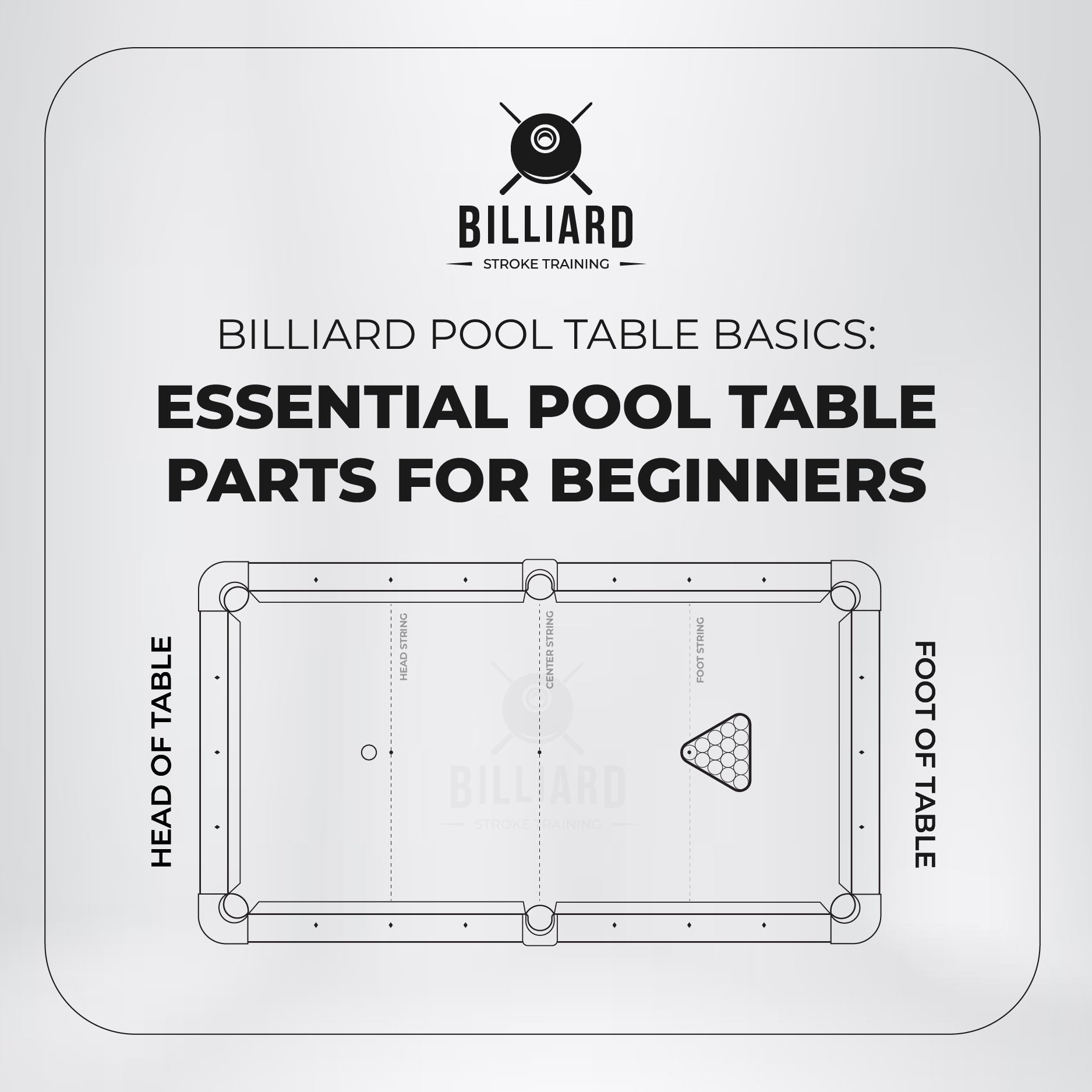
Complete Pool Table Anatomy Diagram
The diagram below shows a bird's-eye view of a standard pool table with all major components labeled. Study this diagram to understand how everything we've discussed relates spatially:
[Image: pool-table-complete-anatomy-diagram.jpg - Comprehensive overhead diagram with all components labeled with numbers corresponding to the reference table below]
Complete Component Reference Chart
Use this comprehensive chart as your quick reference guide for all pool table parts:
| Component | Location | Purpose | Importance |
|---|---|---|---|
| Head of Table | Breaking end | Starting position for play | High |
| Foot of Table | Opposite end from head | Ball racking position | High |
| Head Rail | Short rail at head | Table boundary | Medium |
| Foot Rail | Short rail at foot | Table boundary | Medium |
| Side Rails (Long Rails) | Both long sides (2 total) | Table boundaries, banking surface | High |
| Cushions | Attached to all rails | Ball rebound surface | Very High |
| Corner Pockets | Four corners | Ball targets (easier) | Very High |
| Side Pockets | Middle of long rails (2 total) | Ball targets (harder) | Very High |
| Foot Spot | 1/4 from foot rail, center | Rack center point | Very High |
| Center Spot | Exact center of table | Reference point | Low |
| Head Spot | 1/4 from head rail, center | Reference point | Medium |
| Head String | Through head spot, parallel to head rail | Kitchen boundary | Very High |
| Center String | Lengthwise, through all spots | Table division reference | Low |
| Foot String | Through foot spot, parallel to foot rail | Reference line | Low |
| The Kitchen | Behind head string | Breaking area, ball-in-hand zone | Very High |
| Rail Diamonds | Inlaid along all rails | Aiming and positioning markers | High |
| Cloth (Felt) | Covers playing surface | Ball rolling surface | Very High |
| Slate Bed | Under cloth | Perfectly flat playing surface | Very High |
| Cue Ball | Placed by player | Ball you strike with cue | Very High |
| Object Balls | Various positions | Balls you aim to pocket | Very High |

Understanding Component Relationships
Pool table components don't exist in isolation - they work together as an integrated system:
Structural Hierarchy:
- Foundation: Frame and legs support everything
- Playing surface: Slate bed provides flat base
- Covering: Cloth creates ball rolling surface
- Boundaries: Rails and cushions define limits and provide rebound
- Targets: Pockets serve as shot destinations
- References: Spots, strings, and diamonds guide positioning
Functional Relationships:
- Cushions depend on: Rail attachment, proper height relative to balls
- Spots relate to: Strings, which relate to rail diamonds
- Pockets interact with: Rails, cushions, and cloth edges
- Kitchen defined by: Head string, which passes through head spot
Common Terminology Quiz
Test your knowledge of pool table anatomy. Try to answer these questions before checking the answers below:
- Where is the cue ball placed when breaking in 8-ball?
- Which pockets are typically harder to make: corner or side?
- What's the difference between a rail and a cushion?
- Where is the 9-ball positioned when racking for 9-ball?
- How many rail diamonds are typically on a long rail?
- What's the 2:1 ratio rule for pool tables?
- What material is under the cloth on quality tables?
- Which spot is used as the center of the rack?
- Behind the head string (in the kitchen), anywhere the player chooses
- Side pockets are harder despite being wider (narrower acceptance angle)
- Rail is the wooden frame; cushion is the rubber bumper attached to it
- In the center of the diamond rack (5th position)
- Typically 8 diamonds per long rail
- Playing surface length is always exactly twice the width
- Slate (natural stone ground perfectly flat)
- Foot spot (at the foot end of the table)
Downloadable Reference Guide
For easy reference during practice sessions, consider these helpful resources:
- Print the diagram: Keep a labeled diagram near your table
- Create flashcards: Term on one side, definition and location on the other
- Mark practice spots: Use chalk or small stickers to temporarily mark the three spots
- String visualization: Run yarn or string along the head string temporarily to visualize the kitchen boundary
Next Steps in Your Learning Journey
Now that you understand pool table anatomy, you're ready to:
- Learn specific game rules: 8-ball, 9-ball, and other popular games
- Develop aiming skills: Use spots and strings for positioning
- Practice banking systems: Utilize rail diamonds for calculated shots
- Understand advanced positioning: Use table geometry strategically
- Study break techniques: Optimize your position within the kitchen
💡 Practice Drill: Table Geography
Stand at the table and practice this exercise:
- Point to each of the three spots and name them
- Identify where each string would be (imagine the lines)
- Count the rail diamonds on each side
- Name each pocket by position (e.g., "upper right corner")
- Identify which area is the kitchen
Repeat this drill until you can quickly identify any table component without hesitation. This foundation makes learning game rules and strategies much easier.
Conclusion
Understanding pool table anatomy transforms you from a confused beginner to a knowledgeable player who can follow rules, communicate effectively, and strategize intelligently. Every component we've covered - from the head and foot orientation to the invisible strings and visible diamonds - serves a specific purpose in creating the structured playing environment that makes pool such a precise and strategic game.
The playing surface provides the flat foundation, rails and cushions create predictable boundaries, pockets offer specific targets, and the reference marks (spots, strings, and diamonds) give you the navigation system to position shots accurately. Quality components in each of these areas separate professional-grade tables from recreational ones, but the fundamental anatomy remains consistent regardless of price point.
As you continue your pool journey, this knowledge of table anatomy will serve as your foundation. When you hear terms like "behind the head string," "on the foot spot," or "two diamonds from the corner," you'll understand exactly what's being communicated. When you're planning position play or calculating bank shots, these reference points will be your mental map. And when you're ready to purchase your own table, you'll know what quality indicators to look for in each component.
Remember: every professional player started exactly where you are now - learning the basics of table anatomy. The difference between beginners and experts isn't innate talent; it's knowledge, practice, and proper fundamentals. You've now taken a crucial first step by understanding your playing environment. The next steps - developing your stroke, learning game rules, and mastering strategy - will build naturally on this foundation.
Keep this guide handy as you practice and play. Refer back to the reference chart when you encounter unfamiliar terms. Most importantly, spend time at the table observing these components in action, and you'll quickly internalize this knowledge through practical experience.
🚀 Ready to Put Your Knowledge into Practice?
Understanding pool table anatomy is your foundation. Now take the next step with professional training equipment designed to improve your game faster than table time alone.
Shop All Training Equipment →