
How to Play 9 Ball Pool: Complete Rules & Winning Strategies
📋 Table of Contents
1. What is 9 Ball Pool?
9 ball pool is a rotation game played with only nine object balls numbered 1 through 9, plus the cue ball. Unlike 8 ball where players claim groups of balls, 9 ball requires players to hit balls in sequential numerical order, making it faster-paced and more strategic.
Equipment Used:
- 9 object balls: Numbered 1 through 9 (solid colors only)
- 1 white cue ball: Used to strike the object balls
- Diamond rack: Specific shape for 9 ball setup
- Pocketing all balls in sequence (1-9), then pocketing the 9 ball
- Using a combination shot to pocket the 9 ball after hitting the lowest numbered ball first

9 Ball vs 8 Ball: Key Differences
- Number of balls: 9 balls vs 15 balls
- Play style: Sequential rotation vs group assignment
- Game pace: Faster games (5-10 minutes vs 15-30 minutes)
- Winning condition: Pocket the 9 ball vs clear your group + 8 ball
- Tournament use: Preferred for professional competitions
- Strategy focus: More emphasis on position and combination shots
- Skill level: Generally considered more challenging
Why Play 9 Ball?
- Faster games: Perfect for quick matches and tournaments
- Professional standard: Used in most major billiard competitions
- Strategic depth: Requires advanced planning and positioning
- Exciting finish: Games can end suddenly with a well-executed combination
- Skill development: Improves overall pool abilities faster
2. Setting Up the Game
How to Rack 9 Ball Pool
- Use a diamond rack (not the triangle rack used for 8 ball)
- Place the 1 ball at the front on the foot spot
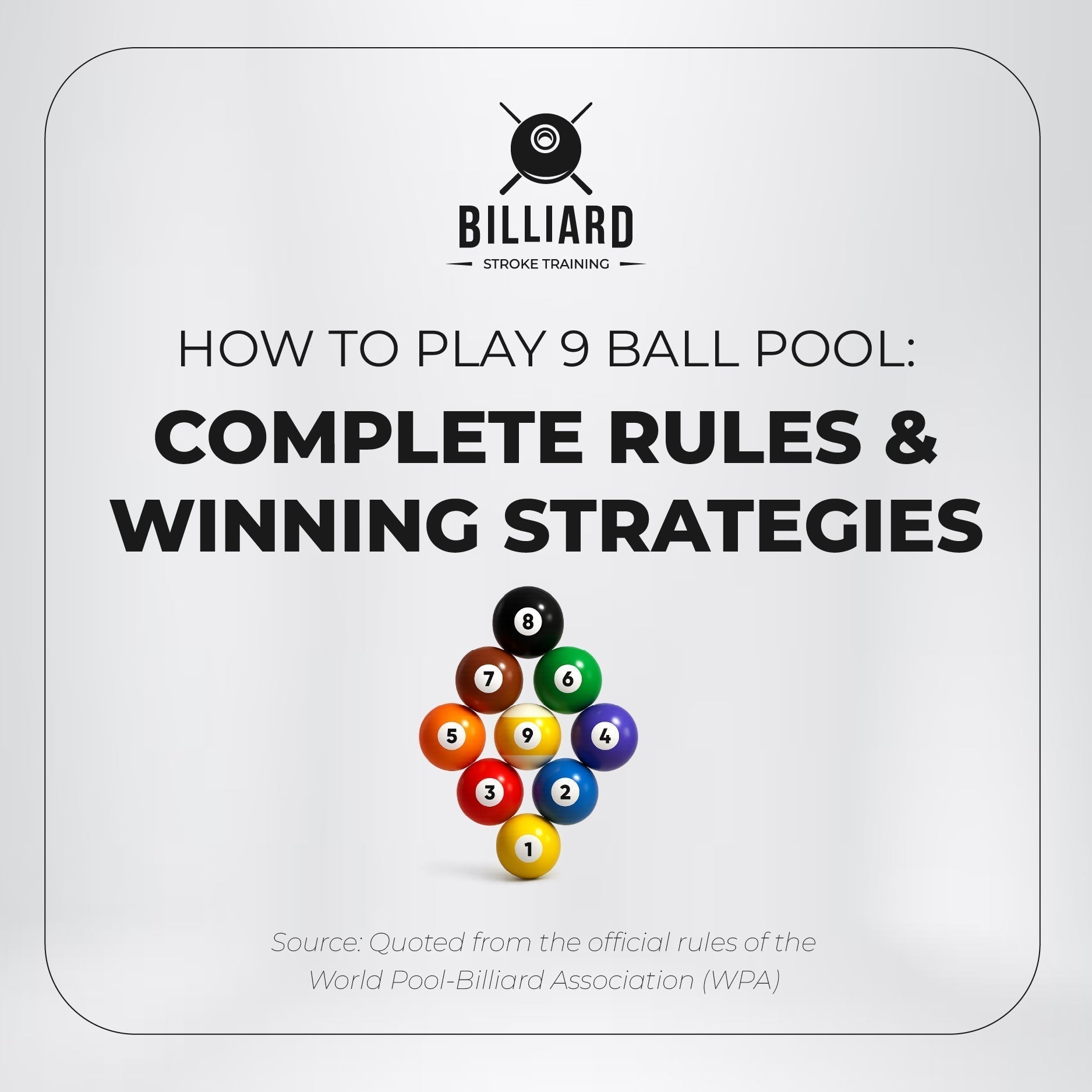
- Place the 9 ball in the center of the diamond (fifth position)
- Arrange remaining balls randomly in the other positions
- Ensure balls are tightly packed with no gaps
- Remove the rack carefully to maintain ball positions
The Break Box
- The cue ball must be placed anywhere behind the head string (break line)
- In tournament play, there's often a designated "break box" area
- Breaking from the side is common for better ball spread
- Some players prefer breaking from the center for maximum power

Determining Who Breaks
- Lag for break (professional standard)
- Flip a coin
- Winner of previous game breaks
- Alternate breaks in match play (race format)
3. Official 9 Ball Pool Rules
1. The Break Shot
Legal Break Requirements:
- Any ball is pocketed (including the 9 ball), OR
- At least four object balls contact the cushions

Illegal Break:
- Opponent may accept the table as is and shoot
- Opponent may require a re-rack with the same breaker
- In some formats, opponent gets ball-in-hand behind the head string
Break and Scratch:
- If you scratch on the break, opponent gets ball-in-hand behind the head string
- Any pocketed balls (except the 9) remain pocketed
- If the 9 ball is pocketed on a scratch, it's spotted on the foot spot
2. The Push Out Rule
After the break, the player at the table may declare a "push out." During a push out:
- The player can shoot the cue ball anywhere on the table
- They do NOT need to hit any ball or a rail
- No balls need to be pocketed
- After the push out, the opponent can choose to shoot or give it back
- This is the ONLY shot where normal rules don't apply
Strategic Use: Use push out when the break leaves you with a difficult or impossible shot. You can move the cue ball to a position where your opponent faces a tough shot, potentially gaining ball-in-hand later.
3. Sequential Play (Rotation Rule)
You must always hit the lowest numbered ball on the table first:
- If the 1 ball is on the table, you must contact it first
- After the 1 is pocketed, you must hit the 2 ball first
- This continues until only the 9 ball remains
- You can pocket any ball on any shot, as long as you hit the lowest number first
- Combination shots are completely legal and strategic

4. Legal Shot Requirements
- Contact the lowest ball first: Cue ball must strike the lowest numbered ball before any other ball
- Pocket a ball OR hit a rail: After contact, either any ball is pocketed, OR any ball (including cue ball) contacts a cushion
5. Pocketing Balls
- Continue shooting: If you legally pocket any ball, you continue your turn
- Any ball counts: You can pocket any ball (not just sequential) as long as you hit the lowest first
- Combination shots: Completely legal and encouraged
- Keep shooting until you miss: String together as many legal shots as possible
6. Winning the Game
- Run the table: Legally pocket all balls 1-8 in sequence, then pocket the 9 ball
- Combination shot: Pocket the 9 ball by combination at any time (after hitting lowest ball first)
- Opponent fouls on the 9: If opponent scratches or fouls while shooting at or pocketing the 9 ball

7. Common Fouls in 9 Ball
Standard Fouls:
- Scratch: Pocketing the cue ball
- Wrong ball first: Failing to contact the lowest numbered ball first
- No rail after contact: Neither pocketing a ball nor driving a ball to a rail after legal contact
- Ball off table: Any ball leaving the playing surface (except legally pocketed)
- Touching balls: Moving any ball with hand, clothing, or cue
- Double hit: Cue tip contacting cue ball twice in one stroke
- Balls still moving: Shooting before all balls have stopped
- No foot on floor: Not having at least one foot touching the floor during a shot
- Jump shot violation: Scooping under the cue ball instead of striking above center
8. Foul Penalties
Unlike 8 ball, when your opponent fouls in 9 ball, you receive ball-in-hand ANYWHERE on the table (not just behind the head string):
- Place the cue ball anywhere you choose
- No restrictions on placement
- Can position for combination shots
- Strategic advantage for run-out
Exception: Fouls on the break give ball-in-hand only behind the head string.
9. Special Rules
If the 9 Ball is Pocketed Illegally:
- The 9 ball is spotted on the foot spot
- If foot spot is occupied, place it as close as possible in a line toward the head spot
- Play continues normally
Jump Shots:
- Legal in 9 ball (unless house rules prohibit)
- Must strike cue ball above its center (no scooping)
- Cue must approach the cue ball at a descending angle
4. How to Play 9 Ball Pool: Step-by-Step Guide
Master the 9 Ball Break
Break Position:
- Many professionals break from the side (1-2 diamonds from the rail)
- Aim at the 1 ball slightly off-center
- Use controlled power (80-90% rather than 100%)
- Focus on cue ball control to avoid scratches
Break Strategy:
- Power break: Maximum force to scatter balls widely
- Controlled break: 80-90% power with focus on leaving a shot
- Second ball break: Hit the 1 ball thin to contact the ball behind it
- Wing ball break: Hit the 1 ball to send wing balls toward corner pockets
Goals on the Break:
- Pocket at least one ball (preferably not the 9 unless you can make it legally)
- Spread the remaining balls across the table
- Leave yourself a shot at the 1 ball
- Avoid leaving your opponent an easy run-out
Understanding Sequential Play
- Always identify the lowest numbered ball first
- Before each shot, confirm which ball you must hit
- Plan your position for the NEXT lowest ball
- Think 2-3 balls ahead in the rotation
Position Play in Rotation:
- After pocketing the 1, position for the 2
- After pocketing the 2, position for the 3
- Continue this pattern throughout the rack
- Always work toward the 9 ball position
Mastering Combination Shots
Types of Combinations:
- Two-ball combo: Hit the lowest ball into another ball into a pocket
- Three-ball combo: Multiple balls in sequence to a pocket
- Carom shots: Cue ball contacts object ball, which contacts another ball
- 9-ball combos: Using any ball to pocket the 9 and win
When to Attempt Combinations:
- When you have ball-in-hand and can set up perfectly
- When the percentage is high (>70% make rate)
- When the alternative is playing safe
- When a 9-ball combo is available
Strategic Use of the Push Out
When to Use Push Out:
- When the break leaves you hooked or with no shot
- When the next ball is difficult to pocket
- To move the cue ball to force opponent into a tough position
- To avoid giving opponent ball-in-hand from a foul
Push Out Strategy:
- Move the cue ball behind your own balls to hook opponent
- Leave the cue ball at the opposite end from the object balls
- Create a situation where opponent must play safe
- Position cue ball where a miss would benefit you
Responding to a Push Out:
- Assess if you can make the shot
- Consider if playing safe is better than shooting
- Think about giving it back if the position is bad
- Evaluate the risk/reward of attempting the shot
Position Play and Pattern Recognition
Reading the Rack:
- Scan all balls and identify potential problems
- Find which balls are clustered or blocked
- Plan the order to pocket balls for best position
- Identify natural paths between balls
Break Out Strategy:
- Address problem balls early in your run
- Use natural break outs when possible
- Calculate the speed needed to separate clusters
- Have a backup plan if the break out fails
Safety Play:
- When no clear shot exists, play safe
- Hide the cue ball behind balls
- Leave opponent hooked or with a difficult shot
- Force opponent to make a mistake
🎯 Perfect Your Aim with Ghost Ball Aim Trainer
Master the ghost ball aiming technique faster with our specialized training tool. This innovative trainer helps you:
- Visualize contact points instantly
- Develop muscle memory for accurate shots
- Practice cut angles with immediate feedback
- Build confidence in shot selection
- Accelerate your learning curve dramatically
Perfect for mastering the sequential shooting required in 9 ball and developing the precision needed for combination shots.
Shop Ghost Ball Trainer →
5. Advanced Strategies and Tips
1. Break Shot Mastery
Professional Break Techniques:
- The Cut Break: Break from the side, hitting the 1 ball at an angle to spread the rack
- The Power Break: Maximum power from slightly off-center to scatter balls
- The Soft Break: Controlled break to maintain better cue ball position
- The Second Ball Break: Hit the 1 ball thin to contact the ball behind it
Break Principles:
- Consistency is more important than power
- Practice the same break shot repeatedly
- Focus on cue ball control to avoid scratching
- Aim for pocketing wing balls (corner balls in the rack)
- Develop a pre-break routine for consistency
2. The Push Out: Advanced Strategy
Offensive Push Out: Move cue ball to a position where opponent must attempt a difficult shot. If they make it, they continue; if they miss, you get ball-in-hand. Create a two-way situation: make it or give you an advantage.
Defensive Push Out: Hide the cue ball completely. Leave opponent hooked with no direct path. Force opponent to play safe or give it back to you.
3. Pattern Play in 9 Ball
- Start by surveying all nine balls
- Identify the most difficult position (usually the 9 ball)
- Work backward: Where should cue ball be for 8 ball to get position on 9?
- Continue working backward through entire sequence
- Address problem balls early in your run
4. Combination Shot Strategy
- Look for natural alignments between balls and pockets
- The 9 ball is your primary combination target
- Always be aware of where the 9 ball is
- Even if you can't make it now, remember it for ball-in-hand situations
- Don't force low-percentage combinations
- Missing often leaves opponent a great position
- Consider playing safe if combination is below 70% make rate
- Exception: If it's your only shot, combinations are worth attempting
5. Safety Play Excellence
Play defense when you don't have a clear shot, when attempting a shot risks selling out, or when you want to force opponent into errors.
- Hide behind balls: Position cue ball behind your object balls
- Distance safety: Move cue ball far from the lowest ball
- Rail safety: Freeze cue ball to the rail for difficult angles
- Cluster safety: Leave cue ball touching a cluster
6. Common Mistakes to Avoid
- Breaking Too Hard: Loss of control leads to scratches. 80-90% power is often more effective.
- Not Using Push Out: Many beginners never use this valuable tool. Learn to recognize when push out is beneficial.
- Forcing Combinations: Attempting low-percentage combos costs games. Assess risk vs reward realistically.
- Poor 9 Ball Position: Failing to plan for the 9 ball early. Always work backward from the 9.
- Neglecting Pattern Play: Shooting one ball at a time without planning. Address problem balls early.
🎱 Master Your Stroke with Billiard Stroke Training Board
Develop a consistent, professional stroke with our Billiard Stroke Training Board. This essential training tool helps you:
- Eliminate unwanted side-to-side movement
- Build muscle memory for straight shots
- Improve follow-through consistency
- Develop proper stroke mechanics faster
- Practice at home anytime
Used by beginners and professionals alike, the Stroke Training Board is the fastest way to develop a reliable, repeatable stroke. Essential for mastering the controlled break and precise position play required in competitive 9 ball.
Shop Stroke Training Board →
6. Frequently Asked Questions
What's the main difference between 9 ball and 8 ball pool?
Do you have to call shots in 9 ball pool?
What is a push out in 9 ball and when should I use it?
Can you win on the break in 9 ball?
What happens if you pocket the 9 ball early with a combination?
Is 9 ball harder than 8 ball?
What does "race to 7" or "race to 9" mean in 9 ball?
Can you jump over balls in 9 ball?
What happens if you scratch in 9 ball?
Can you use the opponent's balls in 9 ball?
7. Practice Tips and Tournament Play
Building Good Habits
Consistent Pre-Shot Routine:
- Identify the lowest numbered ball
- Scan the entire table and plan your pattern
- Visualize the shot and position
- Get into your stance
- Take practice strokes
- Execute with confidence
Focus on Fundamentals: Master your break shot before advancing to complex strategies. Practice sequential shooting to develop rotation instincts. Build cue ball control through repetitive drills.
Essential 9 Ball Practice Drills
Drill 1: Break Practice
- Rack 9 balls properly
- Practice your break 50 times
- Track: scratches, balls pocketed, ball spread
- Goal: Develop consistent, controlled break with low scratch rate
Drill 2: 1-9 Run-Out Drill
- Arrange balls 1-9 in a line down the center of the table
- Practice pocketing them in order with position
- Start over if you miss or get poor position
- Goal: Complete the drill 5 times in a row
Drill 3: Combination Practice
- Set up the 1 ball and 9 ball in various combination positions
- Practice pocketing the 9 ball by combination
- Try different angles and distances
- Goal: 70% success rate on standard combinations
Drill 4: Pattern Play Exercise
- Rack the 9 balls
- Break and survey the table
- Plan the entire run-out before shooting
- Execute your plan
- Goal: Successfully execute planned patterns
Drill 5: Push Out Practice
- Set up difficult positions after breaking
- Practice push outs that leave opponent hooked
- Work on hiding cue ball behind balls
- Goal: Develop instinct for when and how to push out
Advancing to Tournament Play
Understanding Tournament Formats:
- Race format: First to win X games (e.g., race to 9)
- Double elimination: Two losses before elimination
- Round robin: Play against all opponents in group
- Alternative break: Players alternate breaking each game
- Check with local pool halls for league information
- American Poolplayers Association (APA) offers 9 ball divisions
- BCA Pool League (BCAPL) hosts 9 ball tournaments
- United States Professional Poolplayers Association (USPPA) for advanced players
Accelerate Your Improvement with Training Equipment
While practice is essential, using quality training equipment can accelerate your 9 ball improvement by 50-70%. Our specialized training tools provide immediate feedback on your stroke and aim, muscle memory development through repetitive correct practice, and home practice capability so you can train anytime.
Conclusion
Learning how to play 9 ball pool opens up a new dimension in your billiard journey. This fast-paced, strategic game combines the precision of rotation play, the excitement of combination shots, and the mental challenge of tactical decision-making. Whether you're advancing from 8 ball or starting fresh with 9 ball, mastering this game will significantly improve your overall pool skills.
The key to success in 9 ball lies in understanding the unique rules — especially sequential play and the push out — and developing the pattern recognition skills to run racks consistently. Start with fundamentals: master your break shot, develop consistent cue ball control, and practice sequential rotation. Remember that every professional 9 ball player started as a beginner, and with dedicated practice and strategic thinking, you can compete at any level.
🚀 Ready to Master 9 Ball Pool?
Discover our complete range of professional billiard training equipment designed to accelerate your improvement and help you play like a pro. Perfect for tournament preparation and competitive play.
Shop All Training Equipment →
Love this tutorial verry clearly