
Front-Hand English & Back-Hand English (FHE & BHE): The Complete Guide
Key Takeaways
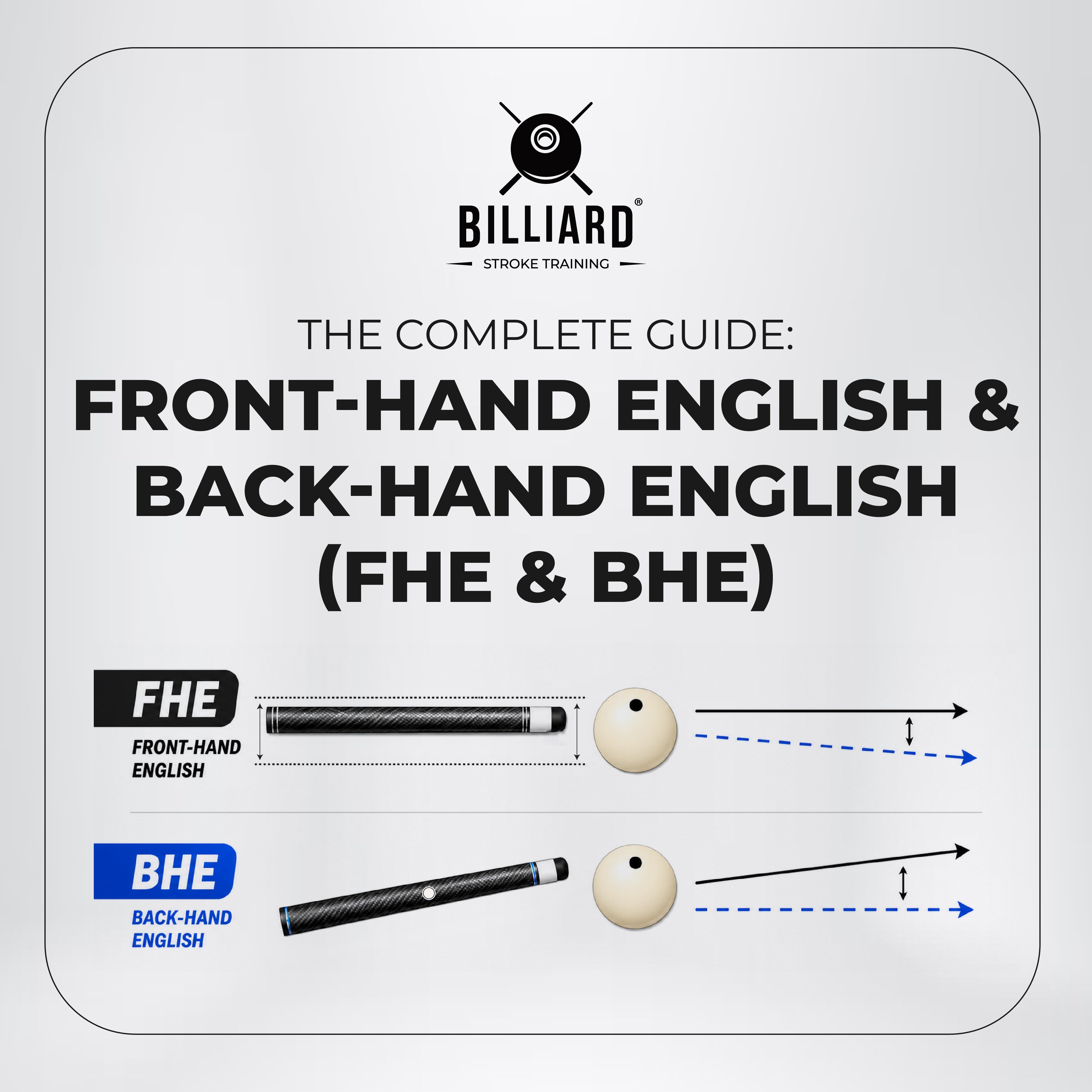
- FHE (Front-Hand English) corrects for deflection by redirecting the front of the stroke — the whole delivery axis shifts so the squirt is pre-aimed through. More adaptable than BHE across varying distances, cue angles, and shot types, but still requires adjustment for swerve on long, slow shots and with an elevated cue.
- BHE (Back-Hand English) corrects for deflection by pivoting the grip end of the cue around the bridge as a fulcrum — aim and English are applied in a single motion. Works best on fast and/or short shots where swerve is negligible; accuracy degrades when swerve has time to develop (long or slow shots).
- BHE is a pivot method. The bridge acts as the fulcrum. The cue pivots around the bridge contact point, so the pivot distance from bridge to cue ball largely determines the angle change — and that must match your shaft's natural squirt angle.
- Neither method accounts for swerve on its own. On long, slow shots, swerve brings the ball back toward the spin side and can over-compensate BHE. FHE is safer on long-distance English shots.
- Both methods fix squirt only. Throw (sidespin friction pushing the object ball off-line) and swerve (cue ball curving back toward spin) are separate effects requiring separate adjustments.
- On rail shots, FHE and BHE apply normally for the initial cue ball delivery. The sidespin's effect on the cue ball after rail contact — running vs reverse English — is a second variable unrelated to squirt compensation.
- Any equipment change (new shaft, new tip) invalidates your calibration. Re-run the NPL drill and FHE calibration drill before relying on English in match play.
- Both methods require the same straight-stroke fundamentals. If your center-ball stroke is inconsistent, neither compensation method will be reliable.
📋 Table of Contents
- 1. The Problem: Why English Pushes the Cue Ball Off-Line
- 2. Front-Hand English (FHE): Front-Side Aim Adjustment
- 3. Back-Hand English (BHE): The Pivot Method
- 4. Comparing FHE and BHE: When to Use Each
- 5. The Swerve Caveat: Why Distance Changes Everything
- 6. Practice Drills
- 7. Throw: The Third Variable FHE/BHE Does Not Fix
- 8. Rail Shots, Running & Reverse English
- 9. Equipment: How Your Shaft Changes Everything
- 10. Combining FHE and BHE: The Hybrid Approach
- 11. Common Mistakes and How to Fix Them
- 12. Frequently Asked Questions
1. The Problem: Why English Pushes the Cue Ball Off-Line
Before you can compensate for deflection, you need to be clear about exactly what is happening at the moment the tip contacts the ball.
When you strike the cue ball off-center horizontally, the cue tip pushes the ball sideways as well as forward. The mass at the end of your shaft resists that sideways push — it pushes back. The result is that the cue ball launches slightly to the side opposite to the English you applied: right English causes the ball to squirt left; left English causes it to squirt right. This is deflection (also called squirt).
The amount of deflection depends on:
- The endmass of the shaft — heavier tip-end = more deflection. Low-deflection (LD) shafts reduce this significantly.
- How far off-center you strike — more English = more deflection.
- Stroke speed — speed does not change the raw squirt angle, but it affects swerve (see Section 5).

2. Front-Hand English (FHE): Front-Side Aim Adjustment
The Mechanical Principle
In FHE, the player adjusts the front side of the cue line so the delivery axis is pre-aimed to account for squirt — either through a small bridge adjustment or a front-hand pivot, depending on the aiming system being used. The tip still contacts the cue ball at the chosen off-center point, but the whole line of delivery has been redirected before the stroke is taken. The key idea is that the correction happens at the front of the cue, in contrast to BHE where it happens at the back.
The squirt still occurs — you are not eliminating it, you are pre-aiming through it.

How to Execute FHE
- Identify the ghost-ball contact point for the shot as if you were playing with no English.
- Decide how much English you will apply (e.g., half-tip right).
- Before taking your stance, adjust the front side of the cue line in the direction of the squirt — typically a small bridge shift or a front-hand pivot around the cue ball contact point (for right English, squirt goes left → adjust the front of the cue line left).
- Maintain that bridge position and take a normal stroke with your chosen English contact.


💡 Visual cue for FHE
Think of FHE as pointing your garden hose slightly left so that despite the water curving right from the wind, it hits the target. You are not fighting the wind — you are pre-aiming through it. The front-side adjustment is small: a few millimetres of bridge shift (or an equivalent front-pivot) for quarter-tip English, increasing with more spin.
Why FHE Is More Adaptable Across Distances
The front-side adjustment redirects the delivery line before the stroke, which makes FHE easier to adapt across different distances. However, longer and slower shots still require swerve adjustment, and elevated-cue shots can introduce additional curve that must be judged separately.
3. Back-Hand English (BHE): The Pivot Method
The Mechanical Principle
In BHE, you leave the bridge hand exactly where it was aimed at the original ghost-ball contact, and instead pivot the back of the cue (grip end) away from the intended English side. Because the bridge acts as the fulcrum, the tip moves toward the English side — simultaneously placing the contact point off-center and re-aiming the shot. For example: to apply right English, pivot the grip to the left; the tip moves right and contacts the right side of the cue ball.
In other words: BHE simultaneously aims the shot AND applies the English in a single motion. You do not need a separate step to shift the bridge or decide how much to compensate — the pivot does both at once.

The Pivot Length Is Critical
BHE works because the amount the tip moves (the English you apply) and the amount the aim shifts (the compensation) are linked by the pivot geometry. Specifically:
- If you pivot around the bridge contact point, the tip-to-bridge distance determines the tip displacement relative to the cue-ball-to-bridge distance.
- There is a specific bridge-to-cue-ball distance — called the natural pivot length (NPL) — at which pivoting the grip around the bridge produces exactly the tip displacement that cancels squirt for a given shaft.
- For most standard (high-squirt) shafts, the NPL is a relatively short bridge-to-cue-ball distance — often in the 9–10 inch range. For LD and carbon fiber shafts (which produce less squirt), the NPL is longer — a low-squirt shaft can sit around 12–13 inches, and the lowest-squirt designs longer still. The reason is geometric: less squirt needs a smaller aim correction, and producing a smaller correction from a fixed tip offset requires a longer lever arm (a longer bridge distance). The exact value depends on your specific shaft and must be found through calibration — there is no universal number.


How to Execute BHE
- Aim your cue at the ghost-ball contact point as normal, with center-ball delivery.
- Without moving the bridge, pivot the grip end of the cue away from the English side (for right English, pivot grip left → tip moves right, contacting the right side of the cue ball).
- The tip now rests off-center on the cue ball and the aim has shifted simultaneously.
- Stroke straight through — do not try to correct or steer during the stroke.
Why BHE Is Not Universal
BHE cancels squirt cleanly only when two conditions are met: the bridge-to-cue-ball distance equals your calibrated NPL, and swerve is negligible. In cue-sports physics, BHE at the natural pivot length works best on fast and/or short-distance shots — situations where the cue ball reaches the object ball before swerve has time to develop. On slow or long shots, swerve adds a second curvature that BHE does not account for, causing the ball to end up on the spin side of the intended line. This is a speed and distance problem combined, not purely a distance problem.
4. Comparing FHE and BHE: When to Use Each
| Factor | FHE (Front-Side Adjustment) | BHE (Pivot / Back Hand) |
|---|---|---|
| Core mechanism | Shifts entire stroke axis to pre-aim through squirt | Pivots grip so tip displacement = aim correction simultaneously |
| Distance dependence | More adaptable across distances, but still needs swerve adjustment | Most accurate near the calibrated natural pivot length (NPL) |
| Elevated cue shots | ✅ More reliable than BHE when cue elevation is required | ❌ Pivot geometry breaks — use FHE instead |
| Cue level sensitivity | Lower than BHE, but elevation still affects swerve and masse behavior | High — any cue elevation changes contact point in unintended ways |
| Pre-shot routine | Two separate steps: choose English, then shift bridge | Single integrated motion: aim + English applied together |
| Learning curve | Moderate — must learn shift amounts by distance + English amount | Lower once NPL is calibrated — automatic once internalised |
| Best for | Longer shots, elevated-cue situations, touch shots, varied distances | Short-to-medium straight shots, fast pace, competition play |
| Swerve interaction | Must adjust bridge shift slightly more on slow long shots | Swerve can help compensate under-shooting on long shots, but unreliably |
5. The Swerve Caveat: Why Distance Changes Everything
Both FHE and BHE are primarily designed to compensate for deflection (squirt). But on longer, slower shots, a second effect — swerve — enters the picture and partially undoes the squirt, bending the ball back toward the spin side.
The interaction looks like this:
- Short, fast shots: Squirt dominates. Ball misses opposite English. FHE and BHE both work well here.
- Medium shots (~3–5 ft), medium speed: Squirt and swerve partially cancel. Near-zero total deviation is possible — this is sometimes called the "cancel point." Less compensation is needed.
- Long, slow shots: Swerve can fully cancel or over-correct squirt, sending the ball back to or past the original aim line. Over-compensating with FHE or BHE will make things worse.
There is no fixed rule for exactly how much to reduce compensation at longer distances — it depends on your cue, your stroke speed, and the cloth conditions on the day. The only way to calibrate this is deliberate practice with distance variation, as covered in Section 6 (Practice Drills).


6. Practice Drills
Drill 1 — Find Your Natural Pivot Length (NPL) for BHE
Setup: Place a ball 4 feet away aimed straight at a pocket. Take a normal straight-shot stance with center ball aim.
Execution:
- Apply half-tip left English by pivoting the grip right (tip moves left, contacting the left side of the cue ball) without moving the bridge.
- Shoot and observe the result.
- If the ball goes right of the pocket, your bridge is too far from the ball (under-compensating). Move closer.
- If the ball goes left, your bridge is too close (over-compensating). Move farther.
- Repeat until you consistently pocket the ball. That bridge-to-ball distance is your NPL.
Goal: Find and memorise your NPL for your current shaft. Mark it mentally as a reference distance.
Drill 2 — FHE Bridge Shift Calibration
Setup: Same straight-in shot from 4 feet.
Execution:
- Apply half-tip left English (tip left of center), but this time shift the bridge to the right to pre-aim.
- Start with a 5–8 mm shift and observe result.
- Adjust shift until you pocket consistently.
- Repeat at 2 feet and 6 feet with the same English. Note how the required shift changes.
Goal: Build a mental reference for bridge shift amounts at different distances. Most players find the shift is roughly constant — this is one of FHE's advantages over BHE.
Drill 3 — Distance Variation with Both Methods
Setup: Mark three positions: 2 ft, 4 ft, 6 ft from the same pocket. Use half-tip right English throughout.
- Shoot each distance with BHE (pivot at your calibrated NPL). Note which distances are accurate and which are not.
- Shoot each distance with FHE (bridge shift). Note results.
- At 6 ft, try a firmer stroke vs. a softer stroke to see swerve's effect.
Goal: Directly experience how BHE degrades at distances far from NPL, and how FHE degrades on long slow shots without swerve adjustment.
Drill 4 — Elevated Cue (FHE Only)
Setup: Place an obstacle ball between cue ball and object ball, forcing you to elevate the cue 15–20° to clear it. Use half-tip right English.
- Attempt BHE — observe the result (contact point shifts unpredictably).
- Switch to FHE with bridge shift — observe the improvement.
Goal: Understand why BHE fails on elevated-cue shots and internalise FHE as the default in those situations.
💡 Practice journal
Record English direction, method (FHE/BHE), bridge distance, distance to object ball, stroke speed, and result for each session. After 3–4 weeks you will have personal calibration data that is far more reliable than any general guideline.
7. Throw: The Third Variable FHE/BHE Does Not Fix
Correcting for deflection with FHE or BHE gets the cue ball to the right contact point on the object ball. But the shot can still miss — because sidespin also causes the object ball to travel on a slightly different line than geometry would predict. This is throw, and it is entirely separate from squirt and swerve.
What Is Throw?
When the cue ball contacts the object ball with sidespin, friction at the contact point drags the object ball slightly sideways before it separates. The result: the object ball is "thrown" off its geometric line by a small angle — typically 1–3°, sometimes more on slow shots with stun.
There are two types relevant here:
- Spin-induced throw: The sidespin of the cue ball grips the object ball surface and deflects it slightly at contact. The direction and magnitude of this throw depends on the cut angle, the amount of spin, the ball speed, and whether the cue ball is in a stun, follow, or draw state — making it difficult to state a simple rule. As a general starting point: inside English (spin toward the cut direction) tends to add throw in the spin direction; outside English tends to reduce or oppose it — but this generalisation breaks down at certain cut angles and speeds.
- Cut-induced throw: Present on any cut shot even with center ball. The cut angle itself creates friction that throws the OB slightly forward of the geometric line. This combines with spin-induced throw.
How Throw Interacts with English Amount and Speed
- More English = more throw on slow-to-medium shots. Full-tip sidespin on a slow stun generates the most throw.
- Faster shots reduce throw because the balls separate faster and the friction window is shorter. Hard shots with English have less throw than soft shots with the same English.
- Follow reduces throw; draw also reduces it. Center ball with English produces the most throw at a given speed.
- Frozen or near-frozen combinations are extremely sensitive to throw — even small amounts of sidespin on the cue ball can move the object ball significantly off-line through the cluster.
Compensating for Throw
Because throw's direction and magnitude are context-dependent, the practical approach is:
- After applying FHE or BHE to fix squirt, observe which direction the OB misses. If it consistently misses in the spin direction, introduce a small OB aim adjustment against the spin.
- On slow shots near half-ball cut angles with significant English, throw is largest — but the exact adjustment depends on your equipment and speed. Calibrate through practice rather than using a fixed number.
- On fast shots, throw is minimal — no additional adjustment needed.
💡 Practical priority order
1. Fix squirt first (FHE or BHE). 2. Adjust for swerve based on distance and speed. 3. Allow for throw by aiming OB line slightly against the spin. In practice, these three become one feel after enough deliberate repetition — but they must be understood separately first.
8. FHE, BHE and Rail Shots
9. Equipment: How Your Shaft Changes Everything
FHE and BHE are not shaft-agnostic techniques. The squirt angle produced by your shaft determines exactly how much bridge shift (FHE) or pivot angle (BHE) you need. Changing equipment without re-calibrating is one of the most common reasons experienced players suddenly find their English game unreliable.

Standard vs Low-Deflection Shafts
The cause of squirt is the endmass of the shaft — the mass concentrated near the tip that resists the sideways push at contact. Standard shafts (solid maple, standard phenolic tip) have a relatively high endmass and produce significant squirt. Low-deflection (LD) shafts address this in several ways:
- Hollow core or thin-walled construction: Removes mass from the tip end without changing the external profile.
- Carbon fiber shafts: Lower density throughout, resulting in very low endmass and minimal squirt.
- Tapered splice designs: Some manufacturers use wood with varying density profiles to reduce tip-end mass.
Tip Hardness and Size
Beyond the shaft, the tip itself affects squirt and throw:
- Harder tips transfer energy more quickly and produce slightly less squirt and throw than soft tips, though the effect on squirt is minor — endmass remains the dominant factor. They hold chalk less well and have a smaller effective contact window.
- Softer tips grip the ball longer, imparting more spin for the same stroke. They also produce marginally more throw. The contact window is larger, making off-center contact easier to achieve consistently.
- Tip size (diameter) does not significantly affect squirt angle for the same offset distance, but it affects how far off-center you can strike before a miscue — a larger tip allows more English range before the edge of the tip rolls off the ball.
Re-Calibrating After Equipment Changes
Any change to your shaft — new cue, new tip, tip replaced — invalidates your previous FHE and BHE calibration. The required re-calibration protocol:
- Run Drill 1 (NPL finder) on the new shaft to establish the new pivot length for BHE.
- Run Drill 2 (FHE calibration) at three distances to establish shift amounts for FHE.
- Spend at least two practice sessions with English-only shots before mixing into normal play.
- Be patient — muscle memory for the old calibration will interfere for several sessions. Do not mix old and new equipment during this period.
10. Combining FHE and BHE: The Hybrid Approach
FHE and BHE are not mutually exclusive. On medium-distance, medium-speed shots — where squirt and swerve are partially cancelling each other — a small pivot (BHE) combined with a small bridge adjustment (FHE) can produce a net compensation that neither method alone handles cleanly. Some advanced aiming systems formalise this idea by combining front-hand and back-hand adjustments across different speed-distance zones, rather than committing to one method for all situations.
This is an advanced concept that requires both methods to be well-internalised before attempting. Learn pure FHE and pure BHE first. The hybrid emerges naturally once you develop feel for the cancel point — the shot condition where squirt and swerve neutralise each other and minimal compensation is needed.
11. Common Mistakes and How to Fix Them
Mistake 1 — Using Too Much English Too Early
What happens: The player uses full-tip English on routine shots, believing it is necessary for position. Errors from squirt, swerve, throw, and inconsistent contact all compound, making shot-making erratic.
Fix: For any shot where quarter-tip or half-tip English achieves the position goal, use that — not more. Reserve full-tip English for situations where position genuinely demands it. Most professional position play uses less English than beginners assume.
Mistake 2 — Mixing FHE and BHE Mid-Shot
What happens: The player starts to pivot (BHE) and then also shifts the bridge (FHE), effectively double-compensating. The ball misses on the over-corrected side. A related error: the player aims with the tip already off-center and then tries to add a BHE pivot on top — BHE must always start from a center-ball aim; the pivot itself creates the off-center contact.
Fix: Decide your method before you get into your stance and commit fully. If you switch mid-approach, back out completely, reset, and start again.
Mistake 3 — Using BHE on an Elevated Cue
What happens: The player needs to play over an obstacle and tries to apply BHE. The elevated pivot moves the tip both sideways and vertically, producing an unpredictable contact point and unexpected spin.
Fix: Any time the cue is elevated more than a few degrees, default to FHE. FHE's front-side adjustment is a horizontal correction and is not affected by cue elevation.
Mistake 4 — Forgetting Throw After Fixing Squirt
What happens: The player applies correct FHE or BHE and the cue ball arrives at the intended ghost-ball position — but the object ball still misses. The player wrongly concludes their squirt compensation was off.
Fix: Once cue ball delivery is confirmed correct, observe which side the OB is missing. If it consistently misses in the direction of the English spin, throw is the cause — adjust the OB aim line slightly against the spin. This is a separate variable from squirt, covered in Section 7.
Conclusion
Front-Hand English and Back-Hand English are not competing philosophies — they are complementary tools, each suited to different shot conditions. BHE's pivot method is fast, integrates aim and spin in a single motion, and is the go-to for short-to-medium range English shots once your NPL is calibrated. FHE is more adaptable across distances and cue angles, but still requires adjustment for swerve, cue elevation, speed, and table conditions. It is the better choice for elevated-cue shots, long-distance English, masse, and any situation that falls outside BHE's calibrated range.
The foundation under both methods is identical: a straight, repeatable center-ball stroke. Build that first. Then calibrate your BHE pivot length on your own shaft. Then practice FHE shifts at various distances. Remember that squirt is only one of three forces affecting an English shot — swerve and throw must be accounted for separately, each with its own distance and speed dependency.
Over time, the full picture becomes automatic: FHE or BHE fixes squirt; reduced compensation on long slow shots accounts for swerve; a slight OB aim adjustment handles throw. Professionals do not consciously think through these steps — the layered correction has been practiced to the point of instinct. The path to that instinct is deliberate, systematic practice with a single variable at a time. Take it one layer at a time and you will get there.
Frequently Asked Questions
What is the difference between Front-Hand English and Back-Hand English?
Both methods compensate for deflection (squirt) when applying sidespin, but they do it in different places on the cue. Front-Hand English (FHE) adjusts the front side of the cue line to redirect the delivery axis — the tip still contacts the cue ball at the chosen off-center point, but the whole line has been re-aimed. Back-Hand English (BHE) keeps the bridge fixed and pivots the grip end of the cue, so the tip simultaneously moves off-center (creating the English) and re-aims the shot. BHE is faster and integrates aim and spin in one motion; FHE gives more manual control and works in situations where BHE fails.
Why does BHE stop working well at long distances?
BHE uses the bridge as a fulcrum. The pivot correction is geometrically exact only at one specific bridge-to-ball distance — the natural pivot length (NPL) for your shaft. At shorter distances, the tip has displaced proportionally more than the squirt angle requires, so the compensation over-shoots. At longer distances it under-shoots. Additionally, on long shots, swerve develops and partially corrects the squirt by itself — so a full BHE pivot compensation on top of swerve can result in the ball ending up on the wrong side of the target.
Can I use BHE on an elevated cue shot?
Generally, no — BHE becomes unreliable when the cue is noticeably elevated. Pivoting the grip on an elevated cue does not just move the tip sideways: it also changes the vertical contact point on the cue ball. The result is unpredictable spin that does not match the correction you intended. For any shot where the cue is noticeably elevated — playing over an obstacle, steep shot near the rail, masse — always use FHE instead. The bridge shift is a horizontal-only adjustment and is not affected by cue elevation.
Does using a low-deflection (LD) shaft change how I use FHE and BHE?
Yes, significantly. An LD shaft produces less squirt because it has less mass at the tip end. This means: for FHE, you need a smaller bridge shift for the same English amount. For BHE, your natural pivot length is longer — because the shaft squirts less, a given tip offset needs a smaller aim correction, and producing that smaller correction from the pivot requires a longer bridge-to-cue-ball distance (a longer lever arm), so the pivot point sits farther from the tip. If you switch from a standard shaft to an LD shaft (or vice versa), your calibrated NPL and bridge shift amounts are no longer valid and must be re-calibrated from scratch.
What is the natural pivot length (NPL) and how do I find it?
The NPL is the bridge-to-cue-ball distance at which pivoting the grip around the bridge contact point produces exactly the right tip displacement to cancel squirt for a given shaft. Heavier-tipped standard (high-squirt) shafts generally have a shorter NPL — commonly around 9–10 inches; LD and carbon fiber shafts produce less squirt and therefore have a longer NPL, often 12–13 inches or more. The exact value must be found through personal calibration — there is no universal number across shafts and playing conditions. See Drill 1 in Section 6 for the calibration process.
Should I use FHE or BHE as my main method?
Most players find BHE more natural for routine English shots because it is a single integrated motion and, once calibrated, requires no extra pre-shot step. The recommended approach is to learn BHE first for short-to-medium range shots, calibrate your NPL carefully, and then learn FHE as a secondary tool for the situations where BHE breaks down — elevated cue, long-distance shots, very slow shots with significant swerve. Neither method is inherently superior; the combination covers every situation.
Does swerve affect FHE and BHE differently?
Yes. Both methods compensate for squirt, but neither inherently accounts for swerve. However, FHE gives you more direct control: you can consciously apply a smaller bridge shift on long, slow shots to account for the swerve that will develop. With BHE, reducing compensation means changing your pivot angle mid-shot, which is harder to control precisely. For this reason, long, slow English shots are better managed with FHE, where you have direct manual control over the compensation amount.
I've heard of the "pivot method" — is that BHE or FHE?
The pivot method refers to BHE. The classic pivot technique described in instructional literature involves aiming the cue at the ghost-ball contact point with center ball, then pivoting the back of the cue toward the English side until the tip lands on the chosen off-center contact point. The bridge acts as the pivot fulcrum. FHE is sometimes called the "bridge shift method" to distinguish it from the pivot. Both appear in instructional literature under various names — the key is to understand the mechanical difference, not the label.
🎯 Build the Stroke That Makes FHE and BHE Work
Both compensation methods depend on one thing: a straight, consistent cue delivery. Explore our training collection — designed to develop exactly that.
Browse Training Collection →