
English, Deflection & Swerve in Pool: Full Guide
Key Takeaways
- English (sidespin) is horizontal spin from striking left or right of the cue ball's center; it controls how the cue ball comes off rails and how it throws the object ball.
- Deflection (squirt) happens instantly at contact and pushes the cue ball opposite to the side you spin - right English squirts the ball left. It is caused by the endmass of your shaft, not by how hard you hit.
- Swerve happens gradually after the ball is rolling: a slightly elevated cue makes the spinning ball curve back toward the spin direction. It comes from friction with the cloth - not the Magnus effect.
- Squirt and swerve work against each other, so the same English behaves differently at short, medium, and long distances - which is why your aim adjustment must change with the shot.
- Master a straight center-ball stroke first, then add small amounts of English. Beginners almost always use far too much spin too soon.
📋 Table of Contents
1. Understanding English: The Foundation of Spin
English, also called sidespin, is the horizontal spin imparted to the cue ball when you strike it left or right of the vertical centerline. This seemingly simple concept is actually the foundation for advanced position play, rail work, and shot control. Understanding English properly is essential before tackling the more complex effects of deflection and swerve.
What is English?
When you strike the cue ball off-center horizontally, you create sidespin - the ball rotates around a vertical axis as it travels. This rotation profoundly affects the ball's behavior:
- Left English: Striking left of center creates clockwise spin (viewed from above)
- Right English: Striking right of center creates counterclockwise spin (viewed from above)
- Running English: Sidespin that helps the cue ball come off rails at wider angles
- Reverse English: Sidespin that fights the natural angle, bringing the cue ball off rails at sharper angles

Contact Point Visualization
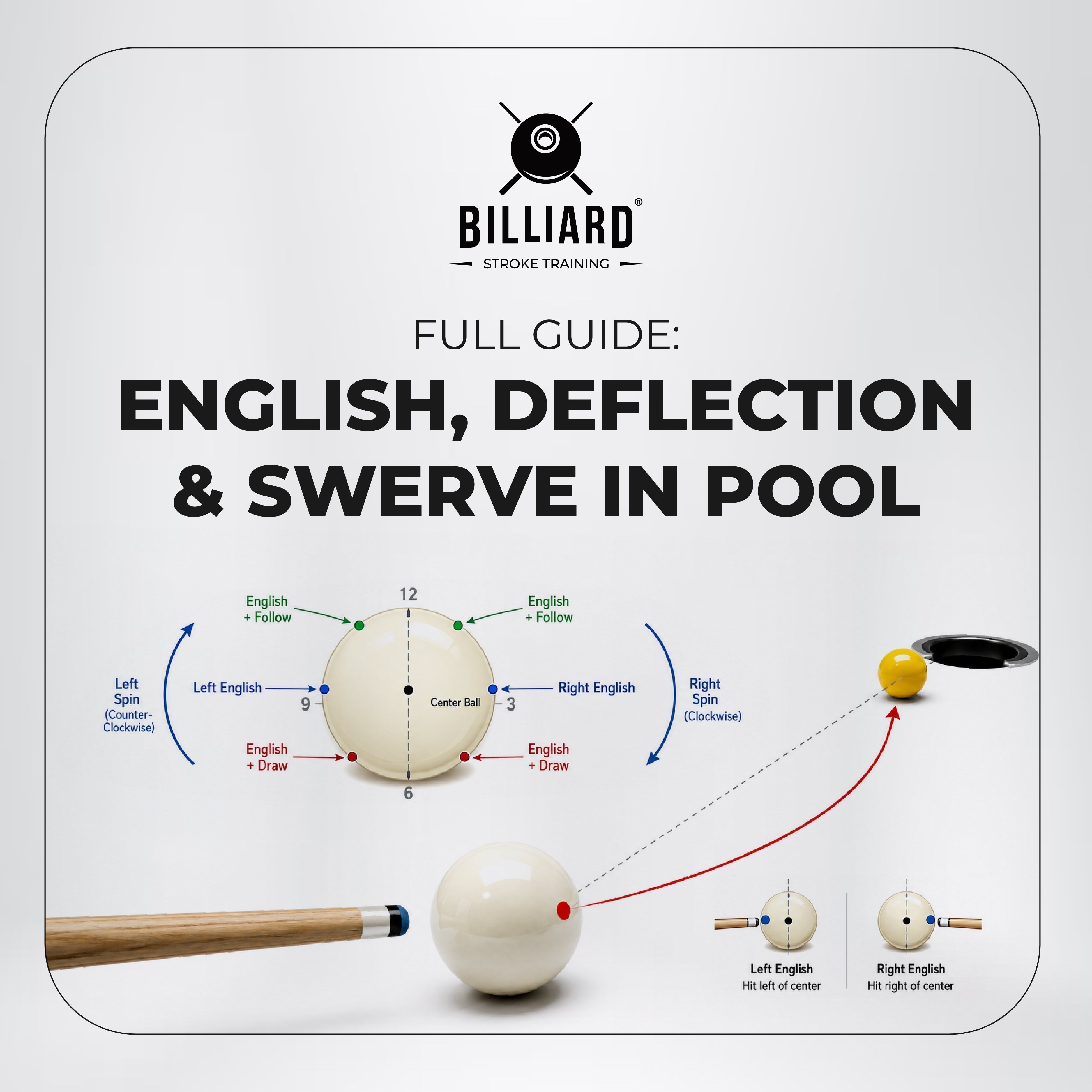
Imagine the cue ball as a clock face viewed from above. The vertical centerline runs from 12 o'clock to 6 o'clock. English is applied at 9 o'clock (left) or 3 o'clock (right) positions. You can combine horizontal and vertical spin:
- Pure English: Contact at 9:00 or 3:00 (horizontal center)
- English with Follow: Contact at 11:00 or 1:00 (above center, left or right)
- English with Draw: Contact at 7:00 or 5:00 (below center, left or right)
- Center Ball: Contact at dead center (no spin at all)

Players measure English in "tips" - the diameter of the cue tip:
- Quarter-tip: Minimal English, subtle effects
- Half-tip: Moderate English, most commonly used
- One-tip: Maximum safe English without miscuing
- Beyond one-tip: High risk of miscue
Why Use English?
Despite adding complexity to your shots, English is essential for advanced play:
- Position Control: Dictate cue ball angle and speed coming off object balls and rails
- Rail Work: Control angles when the cue ball contacts cushions
- Kick Shots: Hit rails before contacting object balls with predictable results
- Bank Shots: Influence how object balls react when hitting cushions
- Break Control: Manage cue ball path and ball spread on the break
- Throw Adjustment: Counter or enhance object ball deflection at contact


Common Terminology
Different terms describe the same concept:
- "English" - American term for sidespin
- "Side" - British term for the same effect
- "Sidespin" - Technical/descriptive term
All refer to horizontal spin applied by hitting left or right of the cue ball's vertical centerline.
Don't confuse English with topspin (follow) or backspin (draw). Those are vertical spins created by hitting above or below center. English specifically refers to horizontal spin from hitting left or right of center. You can combine both types of spin on the same shot.
2. Cue Ball Deflection: The Squirt Effect
Deflection, commonly called "squirt," is the immediate sideways push that occurs when you apply English. The moment your cue tip strikes the cue ball off-center, the ball doesn't travel straight - it deflects in the opposite direction from your English. This is one of the most important concepts to understand for accurate shooting with sidespin.
What Causes Deflection?
Deflection is a mechanical effect rooted in the mass at the end of your cue shaft (called "endmass"):
- Off-Center Contact: When you hit left or right of center, the cue ball immediately starts to rotate while the tip is still touching it
- Ball Pushes the Tip Sideways: This rotation pushes the cue tip (and the end of the shaft) slightly sideways during contact
- Endmass Resists: The mass at the end of the shaft has inertia - it resists being shoved sideways, so by Newton's Third Law it pushes back on the cue ball with an equal and opposite force
- Opposite Direction: That reaction force is what shoves the cue ball off-line, opposite to where you contacted it
This is why the weight of the last several inches of the shaft - not your stroke - determines how much a cue squirts. It also explains exactly why low-deflection shafts work: they remove mass from the tip end.
- Right English: Cue ball squirts to the LEFT
- Left English: Cue ball squirts to the RIGHT
This happens because of the endmass reaction described above: as the spinning ball pushes the tip end sideways, the inertia of the shaft tip pushes back on the ball in the opposite direction. The heavier the end of the shaft, the more the ball squirts away from your English.


Factors Affecting Deflection Amount
Amount of English Applied:
- More English = More deflection
- Quarter-tip: Minimal, barely noticeable
- Half-tip: Moderate, requires compensation
- Full-tip: Significant, requires substantial aim adjustment
- Maximum English: Severe deflection, difficult to control
Cue Shaft Characteristics:
- Standard wooden shaft: High deflection (most squirt)
- Low-deflection (LD) shaft: 30-50% less squirt than standard
- Carbon fiber shaft: Up to 90% less squirt, most consistent
- Shaft diameter: Thinner shafts generally deflect less
- Shaft taper: Conical taper affects deflection characteristics
Shot Speed:
- Speed does NOT change the raw squirt at contact - squirt depends on endmass, not how hard you hit
- However, speed strongly affects swerve (covered next), which changes where the ball ends up
- Faster shots leave less time for swerve to correct the squirt, so the ball appears to deflect more overall (this is the "net deflection" players actually see)
- Consistent stroke speed is what keeps your net deflection predictable
Visualizing Deflection
Imagine shooting a straight-in shot at a distant corner pocket with right English:
- You aim directly at the pocket
- You strike the cue ball on the right side (3 o'clock position)
- The cue ball immediately deflects LEFT
- The ball misses the object ball to the left
- The amount of the miss depends on distance and English amount
This deflection happens instantly - it's not a gradual curve, but an immediate change in direction at the moment of cue-ball contact.
💡 Simple Deflection Test:
Place the cue ball straight in at a side pocket, about 3 feet away. Aim dead center at the pocket. Apply half-tip right English and shoot. The cue ball will miss left. Apply half-tip left English and it will miss right. The distance of the miss shows your cue's deflection amount.
Low-Deflection Technology
Modern cue manufacturers have developed low-deflection shafts specifically to minimize squirt:
- Construction: Engineered wood cores, lighter end mass
- Benefit: Less compensation needed, more consistent results
- Trade-off: Different feel than traditional shafts
- Adjustment: Switching between standard and LD shafts requires recalibration
Professional players choose based on personal preference - some prefer the "honest feedback" of standard shafts, while others appreciate the forgiveness of LD technology.
3. The Swerve Phenomenon: Curving the Path
While deflection pushes the cue ball off-line immediately, swerve is a separate effect that curves the ball back during travel. Swerve can actually work against deflection, partially canceling it out on longer shots. Understanding both effects and how they interact is crucial for accurate English play.
What is Swerve?
Swerve is the gradual curve in the cue ball's path caused by friction between the ball and the cloth while the ball is sliding with sidespin - and it only happens because the cue is almost never perfectly level. To clear the rails, you nearly always elevate the back of the cue slightly, and that elevation is what lets sidespin curve the ball. (Note: this is NOT the Magnus/aerodynamic effect seen with baseballs or golf balls. Pool balls are far too smooth and slow-moving for air to curve them meaningfully - the curve comes from the cloth, not the air.) Unlike deflection, which happens instantly, swerve develops progressively as the ball travels:
- Initial Launch: Ball leaves the tip with sidespin and an initial squirt
- Sliding Phase: Because the cue is slightly elevated, the spinning ball is briefly sliding across the cloth rather than rolling cleanly
- Cloth Friction Acts: Friction between the sliding ball and the cloth pushes it sideways, toward the spin direction
- Curved Path, Then Straight: The ball gradually curves while sliding; once it grips and starts rolling, it travels in a straight line again

The Critical Difference: Deflection vs Swerve
Deflection (Squirt):
- Happens: INSTANTLY at contact
- Direction: OPPOSITE to spin direction
- Cause: Mechanical push from cue tip
- Duration: Immediate effect
- Example: Right English → Ball deflects LEFT
Swerve:
- Happens: DURING travel
- Direction: TOWARD spin direction
- Cause: Cloth friction while sliding (with an elevated cue)
- Duration: Gradual development
- Example: Right English → Ball curves RIGHT
Net Result: Both effects act on the same shot but in opposite directions. The balance between them depends on distance, speed, and English amount.
Factors Affecting Swerve
Distance to Object Ball:
- Short shots (0-2 feet): Minimal swerve, deflection dominates
- Medium shots (2-4 feet): Swerve begins to counteract deflection
- Long shots (4+ feet): Significant swerve, may overcorrect deflection
Shot Speed:
- Slow shots: More time for swerve to develop, more pronounced curve
- Medium speed: Balanced swerve development
- Fast shots: Less time for swerve, minimal curve
Amount of English:
- More sidespin = Greater potential for swerve
- Maximum English creates dramatic swerve on long, slow shots
- Minimal English produces subtle swerve
Cue Elevation (the root cause):
- Perfectly level cue: Almost no swerve - but a truly level cue is rare in real play
- Slight elevation (normal): Because you must clear the rails, a small amount of elevation is nearly always present, producing the everyday swerve described above
- High elevation: Dramatically increases swerve (this is the basis of the curve shot and massé)
The "Sweet Spot" Distance
There's a distance where deflection and swerve approximately cancel each other out - often called the "natural aim point":
- Typically occurs at 2-4 feet distance
- Varies by cue shaft type and stroke speed
- At this distance, minimal aim compensation needed
- Shorter: Compensate for deflection
- Longer: Swerve may require opposite compensation
(drag ↔)
Professional players develop an intuitive feel for the deflection-swerve balance at different distances. They don't consciously calculate - thousands of repetitions create muscle memory for how much to compensate at any given distance. This is why consistent practice with the same cue is essential.
4. How Distance and Speed Affect Spin
The effects of English don't exist in isolation - they interact with distance, speed, and other factors to create the final result. Understanding these interactions separates intermediate players from advanced ones.

Distance Effects on Spin
Short Distance (0-2 feet):
- Deflection: Primary effect, full impact
- Swerve: Minimal, insufficient time to develop
- Net Result: Aim compensation must account almost entirely for deflection
- Strategy: Use less English, or aim slightly toward your English side to counter the squirt
Medium Distance (2-4 feet):
- Deflection: Still significant at contact
- Swerve: Begins to develop, partially counteracts deflection
- Net Result: Effects partially cancel, "natural aim" point
- Strategy: Minimal compensation needed with experience
Long Distance (4+ feet):
- Deflection: Same initial effect
- Swerve: Fully develops, may overcorrect deflection
- Net Result: Ball may actually end up on opposite side of aim line
- Strategy: May need to aim slightly away from English direction
Speed Effects on Spin
Soft Shots (Slow Speed):
- Maximum time for swerve development
- Deflection still occurs at contact
- Swerve becomes dominant on long shots
- Most unpredictable combination of effects
- Difficult for beginners to control
Medium Speed Shots:
- Balanced deflection and swerve interaction
- Most predictable results
- Recommended for learning and practice
- Professional players use this speed most often
Power Shots (High Speed):
- Deflection still present
- Minimal swerve development (insufficient time)
- Deflection dominates even on long shots
- More predictable but requires more compensation
The Throw Effect
An additional complication: friction between the cue ball and object ball at the moment of contact can push the object ball slightly off its expected line. This effect is called "throw." Throw actually comes from two sources, which players often lump together:
- Spin-induced throw (SIT): Caused by your sidespin. As a rough rule, the object ball gets thrown in the direction opposite to the side you spun the cue ball - but the exact direction and amount depend on the cut angle too, so "right English always throws right" is an oversimplification
- Cut-induced throw (CIT): Happens even with NO sidespin, purely from the angle of the cut. The cue ball brushing across the object ball drags it slightly
What makes throw significant in practice:
- Speed: Slow shots produce far more throw than fast ones - throw is largest at slow speed
- Stun is the big one: A slow stun shot (no follow or draw) produces maximum throw. Follow and draw both reduce it noticeably
- Cut angle: CIT is largest near a half-ball hit; it shrinks on very thin cuts and very full hits
- Counterintuitive spin effect: More sidespin does NOT mean more throw. Adding outside spin can even cancel or reverse throw, while adding inside spin to a cut can actually reduce it
For everyday play the practical takeaway is simple: watch out for slow stun shots, especially near a half-ball cut or on frozen/near-frozen combinations - that's where throw will move the object ball enough to miss if you don't allow for it.
On a single shot with English, you're managing:
- Initial deflection (squirt) of the cue ball
- Swerve curving the cue ball path
- Throw affecting the object ball
- Modified cushion angles (if rails involved)
- Changed cue ball path after object ball contact
This is why mastering English takes thousands of practice shots - you're learning to predict and control multiple simultaneous effects.
Equipment Variations
Shaft Type Impact:
- Standard shaft: High deflection, compensation varies greatly with distance
- LD shaft: Reduced deflection, more linear compensation across distances
- Carbon fiber: Minimal deflection, most consistent but different feel
Tip Hardness:
- Soft tips: More grip, easier to apply maximum English, more throw transfer
- Medium tips: Balanced control and durability
- Hard tips: Less grip, harder to apply English, minimal throw
Table Conditions:
- Fast cloth: Ball travels faster, less swerve development time
- Slow cloth: More friction, enhanced swerve effect
- Humidity: Affects cloth speed and cushion response
5. Aiming Compensation Techniques
Understanding deflection and swerve is useless without practical methods to compensate. Professional players use several techniques to account for these effects, and you can choose the method that works best for your game.
Method 1: The Pivot Technique
The pivot method (also called back-hand English, or BHE) is popular because it can compensate for deflection automatically - as long as you use it in the situations it's actually designed for:
- Aim the tip: Place cue tip at the exact contact point you want on the cue ball
- Pivot the butt: Keep tip position fixed, pivot the back end of the cue
- Align for the shot: Adjust until the cue points at the object ball
- Stroke straight: Execute the shot with a straight stroke
Why it works: By pivoting around a point on the cue, you align the cue in a direction that pre-compensates for squirt. But this only cancels squirt cleanly when your bridge sits at the shaft's "natural pivot length" - a specific spot that differs from cue to cue. Each shaft has its own pivot length, so the method must be calibrated to your equipment, not borrowed from someone else's.
Where it shines and where it doesn't: Fixed-bridge pivoting works best on short and/or fast shots, where the ball reaches the target before swerve has time to develop. On longer, slower shots, swerve becomes a major factor and a fixed pivot over-compensates - you'd need a longer effective pivot length (achieved by pivoting from the bridge hand instead, sometimes called front-hand English). Advanced players blend the two to cover all distances and speeds.
Limitations: It is not a "set it and forget it" fix for every shot. It assumes a near-level cue and the correct pivot length for the shot at hand; very short shots, very long/slow shots, and elevated-cue shots all break that assumption and need adjustment.
Method 2: Conscious Aim Adjustment
This method involves deliberately aiming off-target to account for deflection:
- For right English: Aim slightly right — toward your English side — to counter the leftward squirt
- For left English: Aim slightly left — toward your English side — to counter the rightward squirt
- Amount: Varies with distance, English amount, and equipment
- Learning curve: Requires extensive practice to develop feel
Guidelines for compensation:
- Short shots: Aim toward your English side (to offset the squirt)
- Medium shots: Minimal aim adjustment
- Long shots: May need to aim slightly back the other way (swerve can overcorrect)
Method 3: Using Low-Deflection Equipment
The simplest solution: Use equipment that minimizes the problem:
- LD or carbon shafts: Reduce deflection by 50-90%
- Benefit: Less compensation needed, more consistent
- Trade-off: Different feel, no universal standard
- Switching penalty: Hard to alternate between standard and LD shafts
Whichever method you choose, consistency is crucial. You must:
- Use the same cue and shaft consistently
- Maintain consistent stroke speed
- Apply English amounts consistently
- Practice the same compensation method repeatedly
Switching between different cues or methods destroys your calibration and makes accurate English play nearly impossible.
Method 4: The "Feel" Approach
Advanced players develop intuitive compensation through experience:
- Practice: Thousands of repetitions with the same equipment
- Pattern Recognition: Subconscious learning of how shots behave
- Muscle Memory: Body learns proper aim without conscious thought
- Adaptability: Can adjust for different distances automatically
This is the ultimate goal - compensation becomes automatic, allowing you to focus on strategy rather than mechanics.
Practical Compensation Guidelines
For Standard Shaft (High Deflection):
- Half-tip English at 2 feet: Aim about 1/2 ball width toward your English side
- Half-tip English at 4 feet: Minimal adjustment needed
- Half-tip English at 6 feet: May need slight opposite adjustment
For LD Shaft (Low Deflection):
- Half-tip English at 2 feet: Aim about 1/4 ball width toward your English side
- Half-tip English at 4 feet: Minimal adjustment needed
- Half-tip English at 6 feet: Minimal adjustment needed
For Carbon Shaft (Very Low Deflection):
- Aim almost directly at target regardless of distance
- Slight compensation only on extreme English amounts
- Most consistent across all distances
6. Practice Drills and Progression
Knowledge without practice remains theoretical. These structured drills help you develop practical mastery of English, deflection, and swerve through progressive development.
Foundation Drill: Center Ball Mastery
Before adding English, perfect your center-ball stroke:
- Set up straight-in shots at various distances
- Shoot with ZERO English, hitting dead center
- Focus on straight stroke mechanics
- Goal: 95%+ accuracy before adding sidespin
Why this matters: If you can't shoot straight without English, adding English just multiplies inconsistency. Master the foundation first.
Drill 1: Deflection Visualization
Setup:
- Place cue ball 3 feet from a side pocket
- Aim directly at pocket center
- No object ball involved
Execution:
- Shoot with half-tip right English
- Observe miss distance to the left
- Measure and record the miss
- Repeat with left English (misses right)
- Repeat at 2 feet, 4 feet, and 5 feet distances
Learning objectives:
- Visualize actual deflection amount
- Understand how distance affects deflection
- Establish baseline for your equipment
Drill 2: Progressive English Application
Setup:
- Straight-in shot, cue ball to object ball, 3 feet
- Easy pocket shot
Progression:
- Level 1: Quarter-tip English, practice until 80% success
- Level 2: Half-tip English, practice until 70% success
- Level 3: Three-quarter-tip English, practice until 60% success
- Level 4: Full-tip English, practice until 50% success
Key focus: Consistent tip placement at each level. Use training balls with aiming guides if helpful.
Drill 3: Distance Variation
Setup:
- Mark three positions: 2 feet, 4 feet, 6 feet from pocket
- Use half-tip English (consistent amount)
Practice routine:
- Shoot from 2-foot position, compensate for deflection
- Move to 4-foot position, minimal compensation
- Move to 6-foot position, possible opposite compensation
- Return to 2-foot position
- Repeat cycle 10 times
Goal: Develop feel for how compensation requirements change with distance.
Drill 4: Rail Work with English
Setup:
- Cue ball near side rail
- Object ball along rail 3-4 feet away
Variations:
- Running English: Sidespin that widens angle off rail
- Reverse English: Sidespin that shortens angle off rail
- No English: Natural angle as baseline
Learning: Experience how English dramatically affects rail behavior beyond just deflection and swerve.
Drill 5: Speed Control with English
Setup:
- Same shot setup at 4 feet
- Constant half-tip English
Variations:
- Soft stroke (slow speed)
- Medium stroke (controlled speed)
- Firm stroke (faster speed)
Observe: How speed affects both deflection compensation and swerve development.
💡 Practice Journal Recommendation:
Keep notes on each practice session:
- English amount used
- Distance to object ball
- Shot speed
- Result (made/missed, direction)
- Compensation that worked
Over time, patterns emerge revealing your personal deflection characteristics and optimal compensation. This accelerates learning far faster than random practice.
Common Mistakes to Avoid
1. Too Much English Too Soon:
- Beginners often apply maximum English unnecessarily
- Start with minimal amounts, increase gradually
- Professional players use less English than beginners think
2. Inconsistent Contact Points:
- Intended half-tip becomes quarter-tip or three-quarter-tip
- Practice precise tip placement repeatedly
- Visual aids help develop consistency
3. Switching Equipment:
- Playing with different cues destroys calibration
- Stick with one cue for practice and play
- If you must switch, allow re-calibration time
4. Neglecting Speed Control:
- English effects vary dramatically with speed
- Practice consistent stroke speed
- Hitting harder doesn't improve results
Progression Timeline
Weeks 1-4: Foundation
- Perfect center-ball stroke
- Introduction to quarter-tip English
- Understanding basic deflection
Months 2-3: Development
- Consistent half-tip English application
- Compensation for deflection at various distances
- Basic rail work with sidespin
Months 4-6: Intermediate
- Full-tip English when needed
- Understanding swerve on long shots
- Integration into position play
Months 7-12: Advanced
- Intuitive compensation at all distances
- Speed variation with English
- Creative shot-making applications
Year 2+: Mastery
- Effortless English application
- Automatic compensation
- Teaching others the concepts
Conclusion
Mastering English, deflection, and swerve transforms your pool game from basic to advanced. These interconnected effects seem complex initially, but with proper understanding and structured practice, they become intuitive tools for precision control.
Remember the key principles:
- English creates sidespin - horizontal rotation that affects everything
- Deflection happens instantly - cue ball squirts opposite to English direction
- Swerve develops during travel - ball curves back toward spin direction
- Distance determines dominance - short = deflection, long = swerve
- Speed affects magnitude - slower = more swerve, faster = less
- Equipment matters significantly - LD shafts reduce deflection dramatically
- Consistency is everything - use same cue, build muscle memory
Don't expect overnight mastery. Professional players spend years developing their feel for these effects. The difference is that pros understand WHAT is happening and WHY, so their practice has direction and purpose. Use the drills provided, keep notes on your observations, and gradually build complexity as your control improves.
Every shot in pool is governed by physics. The more accurately you understand and apply these principles - English, deflection, swerve, throw, and their interactions - the more precisely you can control the cue ball. This knowledge transforms you from a player who "hopes" shots work to one who "knows" they will work.
Start with center ball, add English gradually, practice deliberately, and watch as your understanding unlocks position play and shot-making abilities you never thought possible. The journey from beginner to master is long, but with proper fundamentals and structured practice, every shot brings you closer to true cue ball control.
Frequently Asked Questions
What is the difference between deflection (squirt) and swerve?
Deflection, or squirt, happens instantly at the moment of contact: when you apply sidespin, the cue ball pushes off-line in the direction opposite to your English (right English squirts the ball left). It is caused by the mass at the end of your shaft resisting the sideways push of the spinning ball.
Swerve happens gradually after the ball is moving. Because your cue is almost always slightly elevated to clear the rails, the spinning ball slides briefly across the cloth and friction curves it back toward the spin direction. In short: squirt is instant and goes opposite the spin; swerve is gradual and goes with the spin.
Is swerve caused by the Magnus effect like a curveball in baseball?
No. This is a common misconception. The Magnus (aerodynamic) effect requires a rough surface and high speed, like the raised stitches on a baseball or the dimples on a golf ball. Pool balls are far too smooth and travel too slowly for air to curve them in any meaningful way.
Swerve in pool comes from friction between the ball and the cloth while the ball is sliding with sidespin, combined with the slight elevation of the cue. The curve comes from the table, not the air.
Does hitting the ball harder cause more deflection?
Not the raw squirt itself. The amount of squirt depends on the endmass of your shaft, not on how hard you hit. What changes with speed is swerve: a faster shot gives the ball less time to swerve back, so the ball ends up further off-line overall. That larger "net deflection" is what players observe and mistake for more squirt. Keeping a consistent stroke speed is what makes your aim predictable.
Do low-deflection (LD) or carbon fiber shafts really help?
Yes. LD and carbon shafts work by reducing the mass at the tip end of the shaft, which is the actual cause of squirt. Less endmass means the cue ball deflects less, so you need to make smaller aiming adjustments when using English, and your results are more consistent across distances.
The trade-offs are a different feel and the fact that switching back and forth between a standard and an LD shaft forces you to re-calibrate your aim. Pick one and stick with it.
How much English should a beginner use?
Less than you think. Most beginners apply far too much English far too soon, which multiplies every error. Master a straight, center-ball stroke first, then add spin in small amounts - start with a quarter-tip and build up gradually. Professional players use less English than beginners assume, and they reach for center-ball whenever a shot allows it.
What is "throw" and when does it matter most?
Throw is when friction between the cue ball and object ball at contact pushes the object ball slightly off its expected line. It comes from two sources: the cut angle itself (cut-induced throw) and your sidespin (spin-induced throw).
Throw matters most on slow shots, and it is largest on a slow stun shot - especially near a half-ball cut or on frozen and near-frozen combination shots. Follow and draw both reduce it. One counterintuitive point: more sidespin does not mean more throw, and outside spin can even cancel or reverse it.
Why does the same English seem to behave differently at different distances?
Because squirt and swerve work against each other and their balance shifts with distance. On short shots, squirt dominates and the ball misses opposite your English. On medium shots (roughly 2-4 feet), swerve has had time to partly cancel the squirt - this is the "natural aim point" where little compensation is needed. On long, slower shots, swerve can fully develop and even overcorrect, sending the ball to the other side. This is why your aim adjustment has to change with the shot.
Why does the pivot (back-hand English) method not work on every shot?
The pivot method only cancels squirt cleanly when your bridge sits at your shaft's "natural pivot length," which differs from cue to cue and must be calibrated to your own equipment. It works best on short and/or fast shots, where swerve has not had time to develop.
On longer, slower shots, swerve becomes a big factor and a fixed pivot over-compensates, so you need a longer effective pivot length (pivoting from the bridge hand instead). It also assumes a near-level cue, so elevated-cue shots break the method too. It is a strong starting point, not a fix for every situation.
How long does it take to get good at using English?
There is no shortcut, but there is a sensible progression. Expect to spend the first month or so perfecting your center-ball stroke and getting comfortable with small amounts of English. Over the next several months you build consistent compensation at various distances, and intuitive control typically develops over a year or more of deliberate practice. Keeping a practice journal of what English, distance, speed, and result you got dramatically speeds this up compared to random practice.
🚀 Ready to Master Cue Ball Physics?
Understanding English, deflection, and swerve is just the beginning. Elevate your game with professional training equipment designed to develop precise cue ball control faster and more effectively.
Shop All Training Equipment →