
What Is a Ghost Ball & How to Use It in Pool (Full Guide)
Key Takeaways
- The ghost ball is the imaginary position the cue ball must occupy at contact to pocket the object ball — one ball-width back from the object ball, directly along the line to the pocket.
- Aiming is a learnable skill, not natural talent. The hard part for beginners is seeing the ghost ball; a physical trainer removes that barrier instantly.
- Repetition at a fixed position is the key to lasting improvement. Shooting the same cut angle repeatedly encodes the feel of correct aim into muscle memory — so the next time you face that angle in a real game, your body already knows it.
- Practicing across many table positions builds a complete "library" of remembered angles, which is what separates consistent players from streaky ones.
- The ghost ball method also works for combination shots — you simply chain two ghost ball positions together.
📋 Table of Contents
1. What Is a Ghost Ball?
The ghost ball is an imaginary cue ball positioned exactly where the real cue ball needs to be at the instant it contacts the object ball. If you could freeze that moment, the cue ball would be sitting one ball-width behind the object ball, directly along the straight line running from the pocket through the center of the object ball.
Pocket a ball and the logic is simple: the object ball travels in the direction it is pushed, which is directly away from the contact point. To send it toward the pocket, the cue ball must strike it from the opposite side — the ghost ball position marks exactly where that contact happens.

Why the Ghost Ball Is Hard to "See"
The concept is simple, but applying it is where beginners struggle. The ghost ball is invisible — there is no physical marker on the table showing where it sits. Your brain has to project a 3D sphere into empty space and then aim at it. For an experienced player this becomes automatic, but for a beginner it is genuinely difficult: the eyes have nothing concrete to lock onto, so the estimate drifts, and the shot misses.
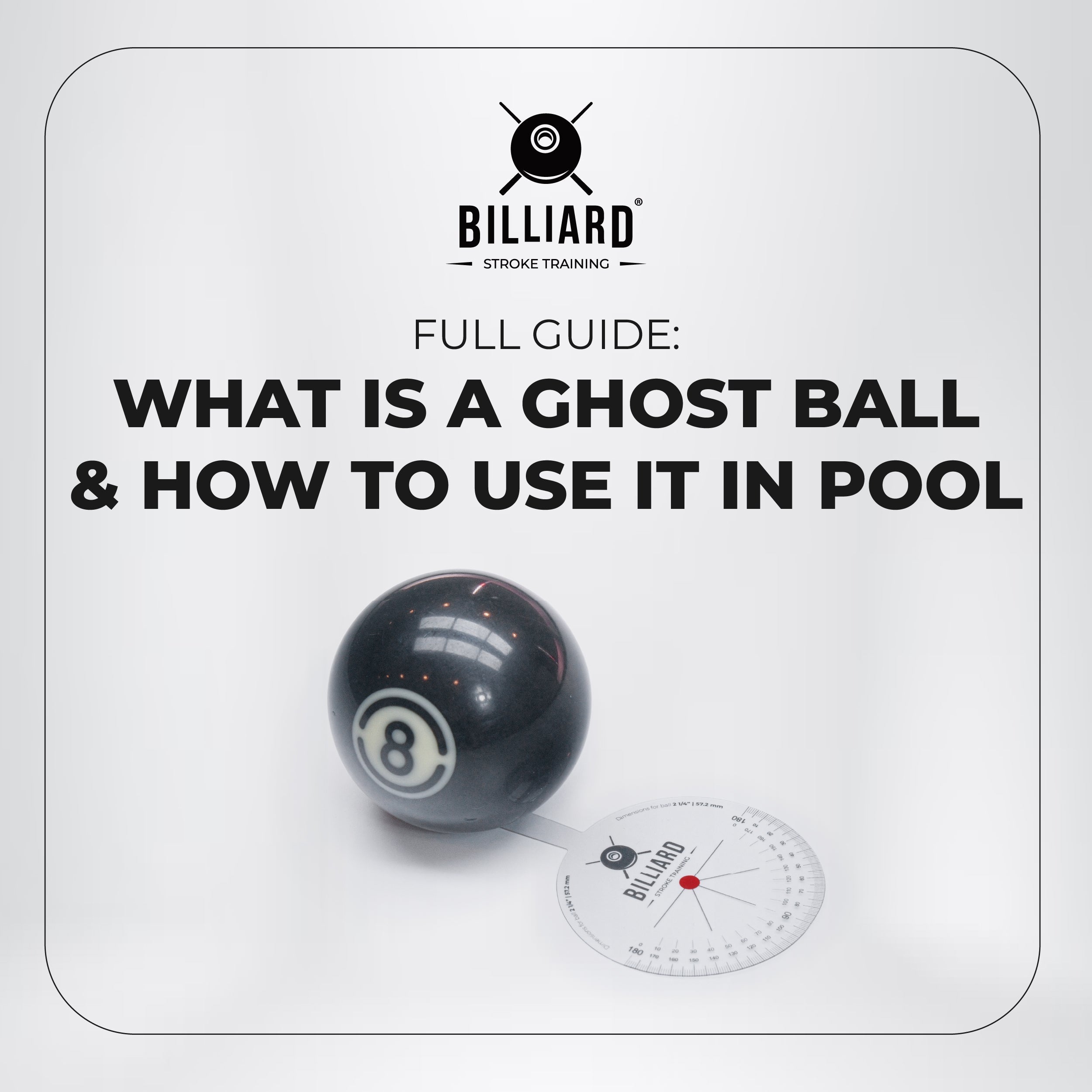
This is the exact problem a physical ghost ball trainer solves. By placing a real, visible reference where the ghost ball should be, it removes the guesswork entirely — you see the true ball-on-ball relationship instead of imagining it. The visible reference is what lets your brain start recording what correct aim actually looks and feels like.
2. How to Use the Ghost Ball (Step by Step)
Using the ghost ball method follows a consistent routine for every shot. The more you follow the same sequence, the faster it becomes second nature.
Find the Line to the Pocket
Look at the object ball and the pocket you want to make. Picture the straight line running from the center of the pocket through the center of the object ball, and extending out the back of it. This line is the direction the object ball must travel.
Place the Ghost Ball
Picture (or physically place a ghost ball trainer at) a cue ball sitting on that line, touching the back of the object ball — one ball-width behind it. This is the position your real cue ball must occupy at contact.
Aim the Cue Ball at the Ghost Ball
Now shift your focus to your cue ball. Aim to drive its center to the exact spot where the ghost ball sits. You are no longer aiming at the object ball directly — you are aiming at the ghost ball position.
Stroke Straight Through
Deliver a straight, smooth stroke sending the cue ball to the ghost ball position. If your aim was correct and your stroke was straight, the object ball rolls toward the pocket.


💡 Why a transparent trainer matters
A see-through ghost ball card lets you look straight through it to the object ball and pocket, so you can confirm the alignment is correct before you shoot. Opaque aids block your view of the very relationship you are trying to learn. The printed angle markings on a quality trainer also let you study exactly how the contact point shifts as the cut angle changes.
Ghost Ball vs Other Aiming Systems
You may have heard of other methods — fractional aiming (half-ball, quarter-ball), contact-point aiming, or pivot-based systems. These are all valid, but they are more abstract: they ask you to judge fractions of a ball or pivot angles in your head. The ghost ball method is the most visual and intuitive starting point, because it maps directly onto something concrete — a ball-shaped position in space. Most players learn the ghost ball first, then layer the other systems on top once their eyes are trained.
3. Practicing at Different Table Positions: Building Muscle Memory
This is where the ghost ball goes from "a nice concept" to "the thing that actually lowers your miss rate." Understanding the ghost ball intellectually takes five minutes. Building the ability to feel the correct aim instantly, under pressure, in a real game — that takes repetition. And repetition is exactly what the ghost ball method is built for.
How Muscle Memory Actually Works in Aiming
When you shoot the same shot — same cut angle, same distance — over and over, your brain and body record the entire pattern: how the aim looks, how your body lines up, how the stroke feels, and whether the ball went in. Each successful repetition strengthens that recorded pattern. After enough repetitions, you no longer have to consciously calculate the ghost ball position — your body recalls the feeling of correct aim automatically the moment you see that angle again.
This is why a physical ghost ball trainer accelerates learning so dramatically. Every repetition gives you immediate, visible feedback on whether your aim matched the true ghost ball position. You are not reinforcing a guess — you are reinforcing the correct pattern, every single time. Practicing with feedback builds accurate muscle memory; practicing without it just locks in whatever errors you already have.
The Deliberate Practice Principle
Research on skill acquisition consistently shows that the players who improve fastest are not the ones who shoot the most balls randomly — they are the ones who practice deliberately: one specific skill at a time, with immediate feedback, repeated with full attention. A ghost ball trainer turns aiming practice into exactly this kind of deliberate practice. Each position becomes an isolated, measurable skill you can drill until it is automatic.
Work Through the Whole Table
A real game never gives you the same shot twice in a row. So the goal is to build a library of remembered angles covering the positions you will actually face. Practice the ghost ball from a range of positions:
- Straight-in shots — the foundation; no cut angle, pure stroke check.
- Shallow cuts (small angle) — object ball slightly off the straight line.
- Half-ball cuts (around 30°) — the most common game angle.
- Steep cuts (large angle) — where aim errors are punished most.
- Long-distance shots — same angles, but with more distance to magnify aim errors.
- Rail-adjacent shots — object ball near a cushion, changing your sight picture.

A Simple Muscle-Memory Practice Routine
🎯 The "10 × 6" Ghost Ball Routine
- Pick one position and set up the ghost ball trainer.
- Shoot that exact shot 10 times in a row, focusing entirely on matching the ghost ball position each time.
- Move to the next position and repeat — cycle through 6 positions.
- Total: 60 focused reps in about 15–20 minutes.
- Over days and weeks, the feel of each angle becomes automatic. Revisit the same positions so the memory consolidates — repetition over time is what makes it permanent.
4. Combination Shots with the Ghost Ball
Once the basic ghost ball is automatic, the same principle extends to one of the most intimidating shots in pool: the combination shot, where you use one object ball to drive another into the pocket.
Chaining Two Ghost Balls
A combination shot is really just two ghost ball calculations linked together, worked out backward from the pocket:
- Start at the pocket and the final ball (the one you want to pocket). Find the ghost ball position behind it — this is where the first object ball must strike it.
- Now treat that ghost ball position as a mini-target. Look at the first ball and find its ghost ball position — the spot where your cue ball must strike the first ball to send it to the target you just found.
- Aim your cue ball at that second ghost ball position and stroke straight through.
By breaking the combination into two simple ghost ball steps, an intimidating shot becomes two familiar ones. This is exactly why mastering the single ghost ball first pays off — combinations are just the same skill, applied twice.

5. Get Started with a Ghost Ball Trainer
You can practice the ghost ball method by imagining the position — but the fastest, most reliable way to build real aiming muscle memory is with a physical ghost ball trainer that shows you the true position on every single repetition. Every rep with visible feedback is a rep that reinforces correct aim instead of a guess.
🎯 Build Automatic Aim with the Ghost Ball Aim Trainer
Our transparent Ghost Ball Aim Trainer turns the invisible ghost ball into a visible, repeatable target — so every practice rep builds the muscle memory that makes accurate aiming automatic.
- Crystal-clear design shows the true ball-on-ball contact point
- Printed angle markings help you study how aim shifts with cut angle
- Regulation 57.2mm size matches a real pool ball exactly
- Works for every position on the table — build your full library of remembered angles
- Perfect for the "10 × 6" muscle-memory routine in this guide
- Suitable for pool, snooker, and carom
Repeat the same position, build the feel, and carry that automatic aim into every real game.
Shop the Ghost Ball Trainer →