
Why Do I Miss Easy Shots in Pool? 7 Stroke Mistakes Killing Your Game
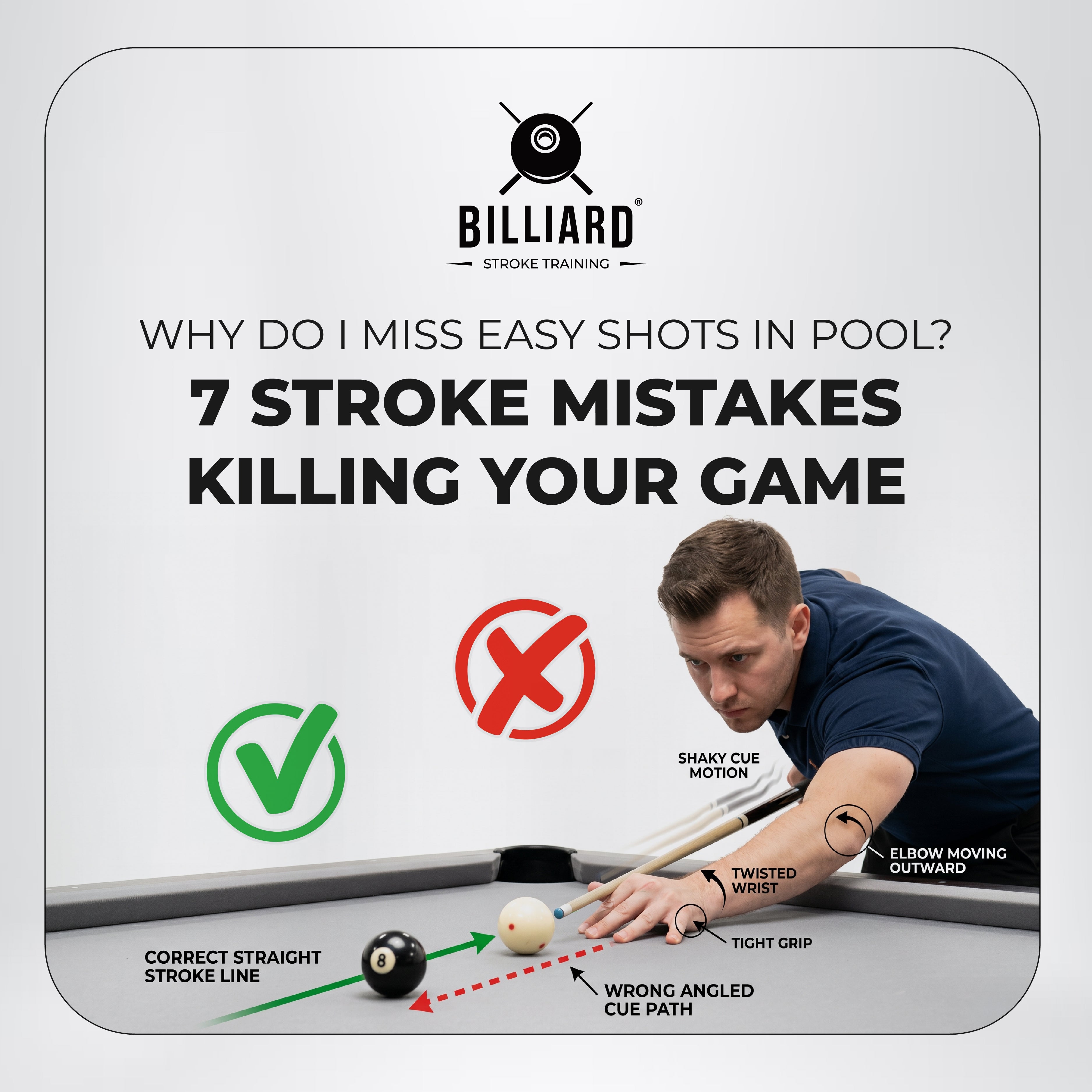
The 8-ball is sitting right in front of the pocket. The cue ball is two feet away. You've made this shot a thousand times. You step up, line up, stroke through — and somehow the ball rattles in the jaws and stays out. Sound familiar?
Missing easy shots isn't a "concentration problem" or bad luck. It's a stroke mechanics problem — and once you know what to look for, the seven hidden errors causing your misses become obvious. This guide walks through each one, how to spot it, and exactly how to fix it. Most players have 2–3 of these errors operating simultaneously without realizing it.
📋 Table of Contents
1. Why Easy Shots Are Actually the Hardest Diagnostic
Here's a counterintuitive truth: missing easy shots reveals more about your game than missing hard shots. When you miss a thin cut across the table, the culprit could be aim, speed, angle calculation, or stroke — too many variables to isolate. But when you miss a straight-in shot from two feet away? Aim isn't the issue. Distance isn't the issue. The only thing left is how the cue stick is delivering the ball.
Easy shots strip away every excuse except one: your stroke. That's why pros use them as diagnostic shots — and why your missed easy shots are actually free intelligence about exactly what's wrong with your mechanics.
Most Misses Come From Mechanics, Not Aim
Among recreational players, missed easy shots come from stroke mechanics errors in roughly 80% of cases. Aim issues account for the remaining 20% — and even those often trace back to inconsistent stroke delivery making consistent aim impossible. The seven mistakes covered below are the most common mechanical culprits, ranked by how often they appear.

2. The 7 Stroke Mistakes Killing Your Game
❌ Mistake #1: Wrist Cocking at Impact
What's happening: Your wrist breaks from its neutral position at the moment of impact — usually rotating slightly inward or outward. This rotation transfers to the cue tip, sending the cue ball off the intended line by 1-3 degrees. Over a two-foot distance, even 1 degree of deviation means missing the pocket entirely.

❌ Mistake #2: Elbow Flying Outward
What's happening: During the forward stroke, your elbow swings outward away from your body instead of staying tucked. This converts your straight piston-style stroke into a curved arc, and the cue tip arrives at the cue ball traveling at an angle rather than straight through.


❌ Mistake #3: Death Grip on the Cue
What's happening: Tight gripping transfers tension throughout your entire stroke arm. The forearm tightens, the wrist locks rigid, the elbow stiffens — and the cue can't move in a fluid straight line. Tight grip is also linked to wrist cocking (Mistake #1), making it a compounding error.

🎯 Can't Tell Which Mistakes You're Making?
The fastest way to identify stroke errors is visual feedback. The Billiard Stroke Training Board shows you exactly where your cue is drifting — and which of these 7 mistakes is responsible. You can't fix what you can't see.
- Visual track lines reveal lateral cue movement instantly
- 3 bridge length zones isolate Mistake #6 (bridge inconsistency)
- Portable design — diagnose your stroke at home, no pool table needed
- Includes virtual ball cards for stroke + aim combination drills

❌ Mistake #4: No Follow-Through
What's happening: Your stroke stops at the cue ball rather than continuing through it. This is the cue sports equivalent of a golfer halting their swing at impact — energy transfer is incomplete, and the cue ball gets unpredictable speed and spin. Subconsciously, many players stop the stroke because they're trying to be "careful" — but careful kills consistency.


❌ Mistake #5: Body Movement During the Stroke
What's happening: Hidden body movement — head tilting, shoulders shifting, hips rotating slightly — disrupts the stroke line invisibly. Your stroke arm might be perfect, but if your shoulders rotate 2 degrees during the shot, the cue path moves with them. This error is invisible without video review or a coach.


❌ Mistake #6: Inconsistent Bridge Length
What's happening: You're using a different bridge distance every shot — sometimes 6 inches from the cue ball, sometimes 10, sometimes 12. The brain calibrates stroke timing and power based on bridge distance; if that distance keeps changing, calibration is impossible. You're essentially playing a new instrument every shot.


❌ Mistake #7: Rushed Backswing Transition
What's happening: You transition from backswing to forward stroke with no pause — turning a smooth two-phase movement into a single hectic motion. The rush eliminates the brain's ability to verify alignment one final time before commitment. Under pressure, the rush gets worse, which is why your match performance dips below your practice performance.


3. How to Diagnose Which Mistakes Are Yours
Knowing the seven mistakes is useful — but you only need to fix the ones that are actually yours. Here's a 3-step diagnostic process to identify your specific errors.
Step 1: Record Yourself From Two Angles
Set up your phone to film yourself from two positions: directly from the side (to catch wrist, elbow, follow-through) and from behind looking down the cue line (to catch lateral movement and body shifts). Take 10 stroke shots from each angle. Don't watch the recording yet — just capture honest footage.
Step 2: Use a Stroke Training Board for Visual Feedback
A stroke training board with visual track lines exposes mechanical errors in real time. Watch where your cue drifts during 20 deliberate strokes. Patterns emerge quickly — most players see their dominant error within the first 5-10 reps.
Step 3: Cross-Reference Symptoms Against the 7 Mistakes
Go back to each of the 7 mistakes above. Read the "symptom" section honestly. Match what you observe in your video and feel in your stroke against those symptoms. Mark each as: "clearly yes," "possibly," "clearly no." Your "clearly yes" mistakes are your priority fixes.
Quick Diagnostic Tip:
If you can't decide between two suspected mistakes, fix the one that comes earliest in the stroke sequence. Bridge length (#6) comes before everything else, so fix that first. Grip pressure (#3) comes second. Tempo (#7) third. Earlier errors create cascading downstream effects — fixing them often resolves later symptoms automatically.
4. Frequently Asked Questions
Why do I keep missing easy shots in pool?
Is missing easy shots a stroke problem or aim problem?
How can I tell which stroke mistake I'm making?
How long does it take to fix a stroke mistake?
Can I fix stroke mistakes without a coach?
5. Your Recovery Plan
Knowing the seven mistakes is step one. Fixing them requires a structured plan, not random practice. Here's the recommended sequence:
Week 1-2: Single Mistake Focus
Pick your most obvious mistake from the diagnostic in Section 3. Run the prescribed fix for 15 minutes daily for two weeks. Don't try to fix everything at once — the brain can only consolidate one motor change at a time. Doing two simultaneously slows progress on both.
Week 3-4: Add Second Mistake
Once your first fix feels natural, add your second-priority mistake. Continue maintaining the first fix during this phase. By week 4, two errors are eliminated and your easy-shot success rate should be noticeably higher.
Week 5+: Continuous Refinement
Continue cycling through any remaining mistakes one at a time. Most players need 3-4 months to eliminate all their major stroke errors completely. The good news: by month 2, you'll already be making shots that previously felt impossible.
Key Takeaways:
- Missing easy shots = stroke problem, not aim problem. Fix mechanics first.
- Most players have 2-4 stroke mistakes operating together — diagnose all of them, fix one at a time.
- Visual feedback tools (stroke training board, video review) are essential for self-correction.
- Early errors cascade into later ones — fix bridge length and grip pressure first.
- Plan on 2-4 weeks per mistake for permanent rewiring.
Conclusion
Missing easy shots in pool isn't a mystery and it isn't bad luck — it's diagnostic information about your stroke mechanics. The seven mistakes covered above account for over 95% of recreational players' missed easy shots, and every one of them has a known, simple fix that works in weeks, not years.
The hardest part is honest diagnosis. Most players resist admitting their stroke has problems because it feels like admitting they're bad at pool. They're not — they're just operating with mechanical flaws that no one ever pointed out. Fix the flaws, and the player you've always wanted to be is already inside you, waiting for the mechanics to catch up.
Pick one mistake from this list. Start the fix today. Two weeks from now, you'll be making shots you've been missing for years — not because you got luckier, but because your stroke finally does what your aim has been telling it to do all along.
🚀 Stop Guessing — Start Diagnosing Your Stroke Today
You can't fix what you can't see. Get the complete diagnostic combo — the Billiard Stroke Training Board + Ghost Ball Aim Trainer — that exposes every one of these 7 mistakes in real time and gives you the tools to fix them.
- Stroke Training Board with visual track lines (catches Mistakes #1, #2, #4, #6, #7)
- Ghost Ball Aim Trainer for the 20% of misses that ARE aim-related
- QR code video tutorials walk through every diagnostic drill
- Designed and patented by Billiard Stroke Training

i appreciate the detailed contents. keep it up your good work