Best Billiard Training Aids for Beginners in 2026 - The Complete Buyer's Guide
Most pool players spend years at the table without ever fixing their fundamental stroke errors — wasting countless hours practicing the wrong way. The right training aid can compress 6 months of trial-and-error into just 30 days of focused practice.
In this guide, we review the 7 best billiard training aids for beginners in 2026, evaluated using 5 science-backed criteria. Whether you're struggling with inconsistent strokes, missed cut shots, or simply don't know where to start — this roundup will help you invest in the right tool from day one. The best billiard training aids for beginners in 2026 are stroke trainers, ghost ball aim cards, cue alignment tools, bridge guides, and structured drill systems — each targeting a specific weakness in the fundamental shot.
📋 Table of Contents
- 1. Why Beginners NEED Training Aids (Not Just More Practice)
- 2. The 5 Types of Billiard Training Aids Explained
- 3. What to Look for in a Quality Training Aid (5 Criteria)
- 4. Top 7 Best Billiard Training Aids for Beginners in 2026
- 5. How to Combine Training Aids for Faster Results
- 6. Frequently Asked Questions
- 7. Your 30-Day Beginner Roadmap with Training Aids
1. Why Beginners NEED Training Aids (Not Just More Practice)
Every beginner has heard the advice: "Just play more." But here's the uncomfortable truth — practicing without feedback is one of the fastest ways to lock in bad habits permanently. Pool is a sport of millimeters, where the difference between a made shot and a missed one often comes down to a single degree of stroke deviation. Without a system to expose those errors, you're not improving — you're just rehearsing your mistakes.
The "Mindless Repetition" Trap
The biggest myth in cue sports is that more table time automatically equals improvement. The reality is far less forgiving. Practicing without feedback reinforces bad habits because the brain encodes movement patterns regardless of accuracy. Whether your stroke is straight or crooked, your nervous system files away the motion as "normal" after enough repetitions.
- 80% of beginners repeat the same fundamental errors without ever noticing
- Without external feedback, the brain locks in flawed mechanics as muscle memory
- Muscle memory is built whether the movement is right OR wrong — there's no built-in error correction
- By the time you realize something is wrong, you've already engraved the pattern
The Science of Deliberate Practice
Research by psychologist Anders Ericsson on expert performance reveals that the players who improve fastest aren't the ones who practice the most — they're the ones who practice with deliberate intention. Four principles separate productive practice from wasted hours:
- Specific goal per session — Working on ONE skill, not "everything"
- Immediate feedback — Knowing within seconds if you executed correctly
- Pushing beyond comfort zone — Practicing slightly above your current ability
- Repetition with intention — Every rep performed mindfully, not on autopilot
Training aids provide what a regular pool table cannot: immediate, measurable feedback on every single stroke. They turn invisible errors into visible ones, allowing your brain to course-correct in real time.

Why "Table Time" Alone Isn't Enough
Most beginners face one of two scenarios — and both work against skill development:
- Pool hall players get table time but no coaching. They see when shots miss, but not why — and develop creative workarounds for fundamental flaws instead of fixing them.
- Home players often don't own a regulation table, or have a smaller bar-box. They're starved for repetitions on the actual surface they'll compete on.
Training aids bridge this gap. They let you isolate and drill specific mechanics without needing a full table or a coach — turning your kitchen counter into a productive practice space.
2. The 5 Types of Billiard Training Aids Explained
Not all training aids serve the same purpose. Choosing the wrong type for your current skill level can waste both money and practice time. Here are the five fundamental categories — what they do, who they're for, and when to use each.
Type #1: Stroke Trainers
- Purpose: Train a straight, repeatable cue stroke with proper follow-through and bridge length consistency
- Form factor: Flat boards, channel guides, or grooved tracks that visualize cue path
- Solves: Wrist cocking, elbow flying, lateral cue movement, inconsistent bridge distance
- Best for: All skill levels — but especially absolute beginners who haven't yet developed muscle memory

Type #2: Aiming Aids / Ghost Ball Trainers
- Purpose: Help players visualize the exact contact point and ghost ball position for every shot angle
- Form factor: Transparent cards, regulation-sized templates, sometimes with printed angle markings
- Solves: Cut shot guesswork, contact point confusion, inability to "see" the ghost ball
- Best for: Beginners to intermediate players who can stroke straight but still miss cut shots

Type #3: Bridge & Stance Guides
- Purpose: Establish a consistent setup — bridge hand position, stance alignment, body orientation
- Form factor: Hand templates, floor decals, body alignment markers
- Solves: Inconsistent stance, body sway during stroke, misaligned shooting position
- Best for: Absolute beginners building foundational mechanics from scratch

Type #4: Cue Ball Control Drills
- Purpose: Develop position play — controlling draw, follow, stun, and english
- Form factor: Target zones, drill maps, marked practice patterns
- Solves: Poor cue ball positioning after the shot, lack of speed control
- Best for: Intermediate players who can already pocket balls but struggle with position

Type #5: Diagnostic Tools
- Purpose: Analyze and identify specific stroke errors objectively
- Form factor: Laser stroke analyzers, video recording setups, mirror systems
- Solves: Hidden mechanical flaws that aren't visible to the naked eye
- Best for: Intermediate to advanced players troubleshooting performance plateaus
3. What to Look for in a Quality Training Aid (5 Criteria)
The training aid market is flooded with gimmicks. Some tools cost hundreds of dollars but deliver almost no real-world improvement, while a well-designed $40 product can transform your game in weeks. Use these 5 criteria to separate the useful from the useless.
Immediate Feedback Mechanism
The single most important feature. A quality training aid tells you instantly whether you executed correctly — through visual cues, physical resistance, or measurable outcomes.
- Good tool: You see or feel the result within 1 second
- Bad tool: You have to guess whether you did it right
Targets a Specific Skill (Not "All-in-One")
Beware of products marketed as "fixes everything." Skill development works through isolation — one mechanical fault corrected at a time. Tools that try to do too much usually accomplish nothing well.
- Good tool: Laser-focused on stroke straightness OR aiming OR position — one thing
- Bad tool: Claims to improve "everything about your game"
Portable & Home-Friendly
The best training aids let you practice without a regulation pool table. If you can only use it at a pool hall, you'll use it less often — and consistency is everything for muscle memory.
- Works on flat surfaces (dining table, desk, floor)
- Compact enough to store easily
- Sets up in under 30 seconds
Durable Material
Cheap plastic and cardboard tools break within months — or worse, warp and give inaccurate feedback. Look for materials that hold up to daily use.
- For stroke trainers: Mica plastic or acrylic > flimsy plastic > cardboard
- For aiming aids: Transparent acrylic > opaque plastic
- Solid edges, no warping, consistent thickness
Backed by a Real Practice System
A great training aid is worthless without clear drill instructions. The best products include structured practice protocols — not just the physical tool itself.
- Clear written or video instructions included
- QR code links to demonstration videos
- Suggested drill progression for different skill levels
- Vague marketing claims ("improves your game" without specifying how)
- No demonstrated feedback mechanism visible in product photos or videos
- Generic stock photos with no real usage demonstrations
- Zero drill instructions or tutorials included
- Single-use thin plastic that bends or warps after a few sessions
- No customer reviews from actual users showing the product in action
4. Top 7 Best Billiard Training Aids for Beginners in 2026
After evaluating dozens of training aids against the 5 criteria above — and gathering feedback from beginner players using each tool consistently over 6+ months — here are the top 7 recommendations for 2026.
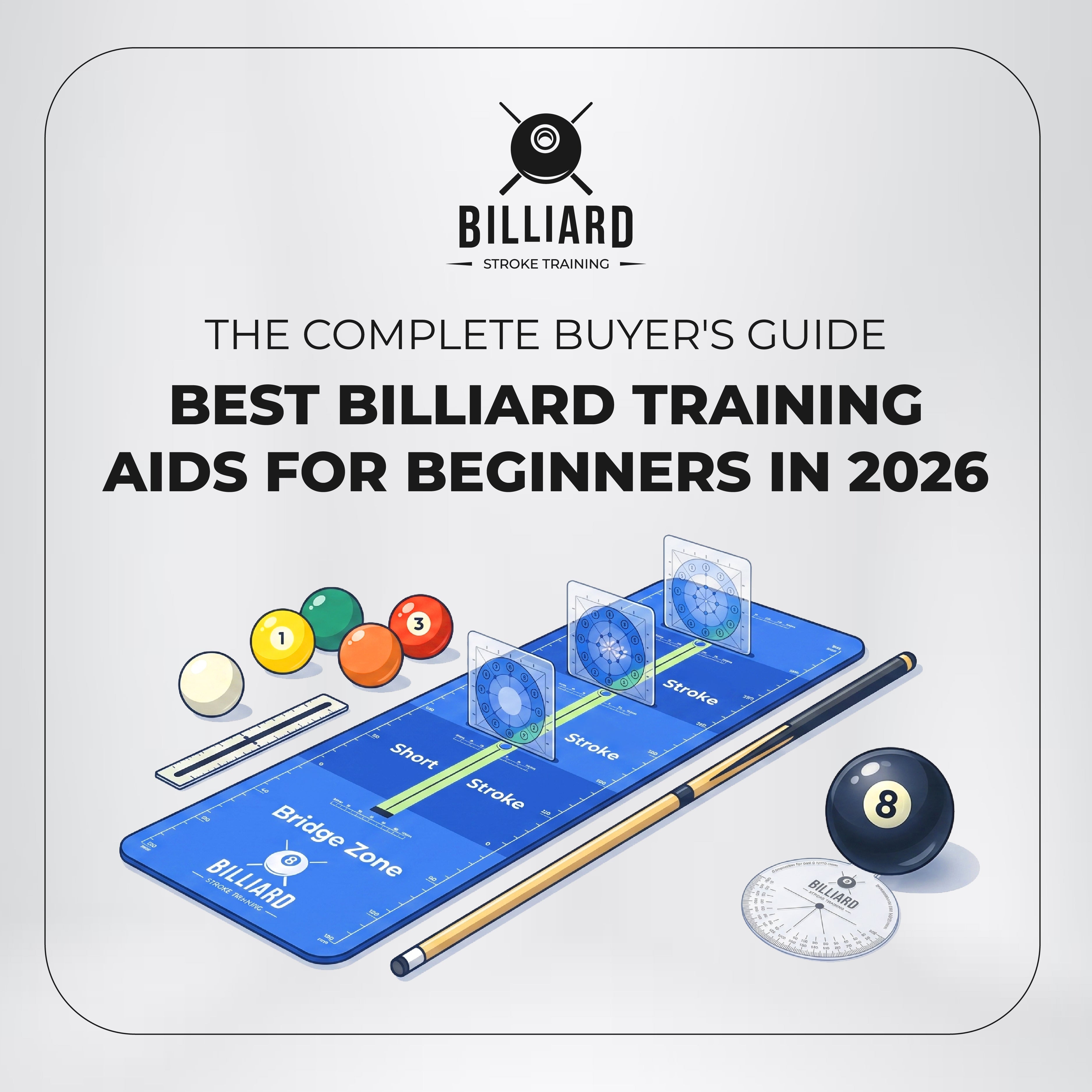
🥇 #1. Billiard Stroke Training Board — Best Overall
Material: Mica plastic (durable, non-warping)
Size: 58 × 18 cm (portable, fits any surface)
Includes: Board + 6 virtual ball cards (4 solid + 2 with center hole)
Best for: Beginners to intermediate players
Disciplines: Pool, Carom, Snooker
Why It's #1
This is the only stroke trainer on the market that integrates three bridge length zones (short, medium, long) onto a single board, with detachable ghost ball cards that turn it into a dual-purpose stroke + aim trainer. The USPTO-registered design is unique — no other product combines these mechanics in one portable system.
Pain Points It Solves
- "I can't tell if my stroke is straight" → Visual track lines on the board provide instant feedback
- "I don't know how far to place my bridge hand" → Three pre-marked zones eliminate guesswork
- "My cue keeps wandering during the stroke" → Physical guidance channels prevent lateral movement
- "I want to practice aim but don't have space for ghost ball drills" → Detachable cards turn the board into an aiming tool
Real Beginner Feedback
"After 2 weeks of using the Stroke Training Board for just 15 minutes a day, my long-distance shots became dramatically more consistent. The bridge length zones were the missing piece I didn't even know I needed." — Verified customer, Texas
🎯 Billiard Stroke Training Board — Master Your Cue Mechanics
The only stroke trainer that combines bridge length control, ghost ball aiming, and follow-through guidance in one portable system. Designed for beginners who want to skip the trial-and-error phase and lock in proper mechanics from day one.
- 3 pre-marked bridge zones for short, medium & long strokes
- Includes 6 virtual ball cards (4 solid + 2 with center holes for physical contact training)
- Compatible with pool, carom & snooker techniques
- Portable 58×18cm size — practice anywhere, no table needed
- QR code video tutorial included with every order
- USPTO-registered design — exclusively from Billiard Stroke Training
Used by beginners worldwide to build proper stroke fundamentals in under 30 days.
Shop the Stroke Training Board →
🥈 #2. Ghost Ball Aim Trainer Card Set — Best for Aiming
Material: Transparent acrylic plastic
Size: 57.2mm (matches regulation pool ball diameter)
Includes: Set of 3 or 6 cards with printed angle markings
Best for: Beginners struggling with cut shots
Disciplines: Pool, Snooker, Carom
Why It's #2
Most ghost ball trainers are opaque — defeating the entire purpose. This one uses crystal-clear acrylic so you can see the true ball-on-ball relationship at the contact point. The printed angle degree markings are a feature you won't find on competitors' products, making it ideal for understanding fractional aiming (half-ball, quarter-ball, three-quarter ball hits).
Pain Points It Solves
- "I can't visualize the ghost ball in my head" → A physical card eliminates the imagination gap entirely
- "My cut shots always miss" → Angle markings show the exact contact point for every cut
- "I don't understand half-ball or quarter-ball aiming" → Visual reference makes aiming systems intuitive
- "I want to learn at home without a pool table" → Pocket-sized, works on any surface
🎱 Ghost Ball Aim Trainer — See Every Shot Before You Take It
Stop guessing where the contact point is. The transparent acrylic design with printed angle markings turns invisible aiming theory into visible, repeatable practice — perfect for beginners breaking through the cut shot barrier.
- Regulation 57.2mm size matches a real pool ball exactly
- Printed angle degree markings for fractional aiming mastery
- Crystal-clear acrylic shows true ball-on-ball contact
- Available in 3-card or 6-card sets for group practice
- Works for all disciplines: pool, snooker, carom
- Pocket-sized portability — practice anywhere, anytime
The fastest way for beginners to break through the "I can't see the ghost ball" barrier.
Shop the Ghost Ball Trainer →
🥉 #3. Cue Tip Shapers & Scuffers — Best Maintenance Tool
Best brands: Kamui, Tweeten Willards
Price range: $15–$40
Function: Maintains cue tip shape and chalk retention
Why It Made the List
While not a skill-building tool in the traditional sense, a properly shaped cue tip is the foundation of consistent ball control. A flat or glazed tip causes miscues and inconsistent english — issues no amount of stroke practice can fix. Every beginner should own a basic shaper and use it weekly.
What to Look For
- Curved shaping surface that maintains nickel-radius dome
- Built-in scuffer for surface texture (better chalk grip)
- Compact enough to carry in a cue case
#4. Practice Cue Ball with Markings — Best for Spin Control
Best brands: Aramith Pro Cup, Elephant Practice Ball
Price range: $25–$45
Function: Visualizes spin and contact point
Why It Made the List
A marked cue ball shows you exactly where your tip struck — turning invisible mistakes into obvious ones. The black dots and red circles let you see if you're consistently hitting center ball or unintentionally putting english on every shot.
Best Use Case
Pair with the Stroke Training Board for the ultimate stroke diagnosis combo: the board shows if your cue moved straight, while the marked ball reveals where your tip actually contacted.
#5. Triangle Rack Templates — Best for Break Practice
Best brands: Outsville, Magic Ball Rack
Price range: $20–$35
Function: Tightens ball racking for consistent breaks
Why It Made the List
The break is the most complex shot in pool, and inconsistent racking sabotages even great break technique. Pre-printed templates ensure tight rack patterns for 8-ball, 9-ball, and 10-ball every time — letting you isolate variables and identify what's actually working in your break.
#6. Pool Stroke Laser Analyzer — Best for Advanced Diagnostics
Price range: $80–$300+
Function: Electronic stroke deviation measurement
Best for: Players willing to invest in data-driven training
Honest Assessment
Laser analyzers provide precise measurements, but for most beginners, they're overkill. The data they generate is meaningless without fundamentals already in place. Save this for after you've mastered basic stroke mechanics with a simpler tool — otherwise, you'll be optimizing flaws instead of building a foundation.
#7. Bridge Stick / Rest — Best Functional Accessory
Price range: $15–$40
Function: Stable bridge for long-reach shots
Why It Made the List
Not technically a "training aid," but for beginners who haven't yet developed strong bridge hand stability, the bridge stick teaches you what a stable bridge should feel like. Use it to learn the position, then phase it out as your hand bridge improves.
5. How to Combine Training Aids for Faster Results
Owning multiple training aids is only effective if you use them in the right order. Most beginners make the mistake of jumping between tools randomly, never giving any single skill enough focused attention to take root. Here's the proven sequence.
The "Stroke First, Aim Second" Rule
This is the single most important principle in beginner training. A bad stroke combined with good aiming still misses the shot — but a good stroke combined with good aiming makes it. Fixing stroke errors first multiplies the effectiveness of every aiming technique you learn afterward.
Why this order works:
- Stroke errors mask aiming errors (you can't tell if you missed because of bad aim or bad stroke)
- Once stroke is consistent, missed shots can be cleanly diagnosed as aim issues
- Aim training compounds faster when stroke is stable
- Aim is mostly mental; stroke is mostly physical — physical patterns take longer to ingrain, so start there
The Beginner Combo: Stroke Board + Ghost Ball Card
This is the most efficient training combination for absolute beginners, addressing both foundational skills in parallel:
- Week 1–2: Stroke Training Board only — 15 minutes per day, focus on consistency
- Week 3–4: Add Ghost Ball Aim Trainer — 10 minutes stroke + 10 minutes aim per day
- Week 4+: Combine both in a single integrated drill — 20 minutes total
Quick Tip — The 70/30 Rule:
Spend 70% of your practice time on the skill you're worst at, and 30% maintaining what you're already good at. Most beginners do the opposite — practicing what's already comfortable while avoiding their weak spots. That's why they stay stuck.

Sample Combo Drill — "The Foundation Shot"
Run this drill 3–4 times per week to integrate stroke and aim simultaneously:
- Place the Stroke Training Board on a flat surface (table or floor)
- Insert a virtual ball card (no-hole version) at the medium bridge zone
- Practice 10 stroke reps focusing entirely on straight follow-through — ignore aim
- Replace with the hole-punched card and practice 10 reps of physical contact through the hole
- Switch to the Ghost Ball Aim Trainer — practice 10 reps identifying contact points for different cut angles
- Combine: take 10 actual shots on a table (or visualized) integrating both skills
Total time: 15–20 minutes. Total reps: 50. The compounding effect of daily integration is what builds real game-transferable skill.
6. Frequently Asked Questions
What is the best billiard training aid for absolute beginners?
Do pool training aids actually work?
How long does it take to see results from using training aids?
Can I use training aids without owning a pool table?
What's the difference between a ghost ball trainer and an aiming system?
Are expensive billiard training aids worth it?
How often should beginners use training aids?
Can training aids help fix bad habits I already have?
What training aid should I buy first as a complete beginner?
Do training aids work for snooker and carom too?
7. Your 30-Day Beginner Roadmap with Training Aids
Here's the proven 30-day progression that takes a complete beginner from inconsistent stroke and missed easy shots to confident, repeatable mechanics. Each week builds on the previous one — skip none of these stages.
Week 1 — Stroke Foundation
- Daily routine: 15 minutes with Stroke Training Board
- Focus: Bridge length consistency, straight follow-through, eliminating wrist movement
- Success metric: 8 out of 10 strokes stay within the board's track lines
Week 2 — Stroke Refinement
- Daily routine: 15 minutes Stroke Board + 5 minutes mirror drill (watch yourself stroke)
- Focus: Tempo, pause at backswing, body stillness through the shot
- Success metric: 9 out of 10 strokes consistent in rhythm and path
Week 3 — Aim Introduction
- Daily routine: 10 minutes Stroke Board + 10 minutes Ghost Ball Trainer
- Focus: Visualizing contact point, full ball hits, identifying ghost ball position quickly
- Success metric: Identify ghost ball position in under 5 seconds for any shot
Week 4 — Integration & Game Transfer
- Daily routine: 10 minutes Stroke + 10 minutes Ghost Ball + 15 minutes table time
- Focus: Applying drills to real shots, executing under "real game" conditions
- Success metric: Make 7 out of 10 easy straight shots in actual gameplay
Key Takeaways from This Guide:
- Training aids work because they provide immediate feedback — the #1 driver of motor learning.
- The Stroke Trainer + Ghost Ball Aim Trainer combo addresses 80% of beginner errors.
- Daily 15–20 minute practice beats long, infrequent sessions for muscle memory development.
- Fix stroke first, aim second — this order matters more than most beginners realize.
- Real, visible improvement is achievable within 2–3 weeks of consistent use.
Beginner Practice Drills to Get Started Today
Practice Drill 1: The Straight-Line Stroke
- Setup: Stroke Training Board on flat surface, medium bridge zone selected
- Reps: 30 strokes per session
- Focus: Cue tip stays inside the track lines throughout the full stroke motion
- Goal: 25 out of 30 successful straight strokes within the lines
Practice Drill 2: The Ghost Ball Hunt
- Setup: Ghost Ball Aim Trainer card on a smooth surface, real cue ball nearby
- Reps: Place card at 10 different random positions and angles
- Focus: Identify cut angle and ghost ball position in under 5 seconds each
- Goal: Complete all 10 identifications in under 60 seconds total
Practice Drill 3: The Foundation Combo
- Setup: Stroke Board with virtual ball card (no-hole version) inserted
- Reps: 10 strokes through the card position
- Focus: Straight stroke + accurate contact at the card center
- Goal: 8 out of 10 reps with both straight stroke AND clean card contact
Conclusion
Choosing the right billiard training aid as a beginner isn't about finding the most expensive tool — it's about finding tools that provide immediate feedback on the skills that matter most: stroke mechanics and aiming fundamentals. Every training aid in our top 7 list earned its spot by addressing a specific, common beginner weakness with measurable feedback.
The path from frustrated beginner to confident shooter doesn't require years of trial-and-error. With the right training aids and just 15–20 minutes of focused daily practice, the muscle memory transformation that used to take 6 months of unstructured play can happen in 30 days of deliberate training. The science is clear: feedback speed and practice consistency outweigh raw practice volume every time.
Whether you start with a stroke trainer, a ghost ball aim card, or both — what matters is that you start today. Every day you practice without proper feedback is another day reinforcing the habits you'll eventually have to unlearn. The earlier you build the right foundation, the faster every future skill stacks on top of it.
🚀 Ready to Transform Your Pool Game?
Get the complete beginner's combo — the Billiard Stroke Training Board + Ghost Ball Aim Trainer — used by players worldwide who want to build proper mechanics from day one. The two foundational tools that handle 80% of beginner errors, in one bundle.
- Master cue stroke mechanics with the patented training board
- Conquer cut shots with the transparent ghost ball aim trainer
- Detailed video tutorials included via QR code
- Works for pool, snooker, and carom
- Backed by Billiard Stroke Training's beginner success system